
Machine-translated from Faroese and not yet reviewed. Read the original.
A short while ago the 16-17-year-old boys came gasping across the finish line in the Danish Championships 3,000 metres. 16-year-old Marnar Djurhuus from Morskranes was considered to have a small chance of winning a medal. And he took that chance! 15 laps were to be run on the 200-metre track in the hall in Skive, and this is what we hear from our source, Guttormur Sørensen:
The first 10 laps were all run fairly evenly at around 36-37 sec. Four boys settled at the front at this pace. The first 1000 metres were covered in about 3:03, and at 2,000 metres they were at about 6:04. Then the pace rose even further. On the 11th lap the favourite and last year’s winner, Sparta runner Zacharias Grassme, ran 32 sec and managed to break away. Marnar also picked up his pace considerably over the last 1000 metres, which he ran in about 2:53 min., and his final time was 8:57.35. This was not fast enough to follow the two leaders, but certainly fast enough to run his way to a safe bronze medal.
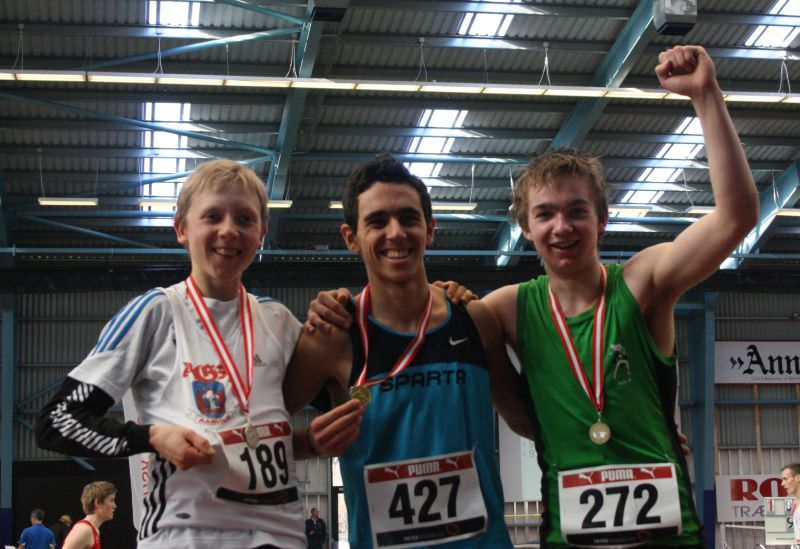
Jacob Simonsen (AGF), Zacharias Grassme (Sparta) and Marnar Djurhuus
The Faroese indoor record is held by Bogi Lenvig. He set it in Malmö in 2004, when he ran the 3,000 metres in 8:55.65.
With this result Marnar is now knocking hard on the door of the Island Games team, as this result gives him more than 750 performance points, which FÍF has set as the A standard. However, the 3,000 metres is neither an Olympic nor an Island Games event, so nothing has been decided in this regard yet.
The results can be seen here: http://mars-net.dk/2011/udmi/resultatliste_D17.htm
FÍF warmly congratulates Marnar on this fine result and wishes him good luck in the 1,500 metres tomorrow.
Late in the afternoon Rebekka Fuglø ran the 800 metres final for girls 18-19. Unfortunately there were only two girls in this race, so they ran together with the 20-22 age group, which also had only two girls. So four girls started this 800 metres. The two older girls took the lead on the first lap, but when Rebekka was given her split time, she took over. The pace on the first of the four laps had been far too slow, and had in effect ruled out her chances of improving her best time and the Faroese record she set at the turn of the month.
Karina Klok, who ran in the same age group as Rebekka, followed. When they reached the 600-metre mark, Rebekka really picked up the pace, and Karina only just managed to hang on. The last 100 metres were a mere formality, and Rebekka could run safely to the finish as Danish champion. The time was not good today – 2:26.18, a good 2 seconds ahead of No. 2. But today it was the gold that counted.

Rebekka ahead of Karina Klok in the 800m





You must be logged in to post a comment.