Machine-translated from Faroese and not yet reviewed. Read the original.
The Faroese talent squad has been to the VU-spelen (World Youth Games) in Gothenburg five times. The competition is very, very strong, and can in many cases be compared with a Nordic championship, perhaps even stronger at times. Even so, we have occasionally managed to reach the podium. In 2006 the then 12-year-old Rúni Seloy won silver over 600 metres, and 13-year-old Rebekka Fuglø won bronze over the same distance. In 2010 Bjørk Herup Olsen won bronze over 1,500 metres for girls 19, and last year we came home with two bronze medals. They came from Marnar Djurhuus over 3,000 metres for boys 15 and Katarina Høj over 600 metres for girls 12.
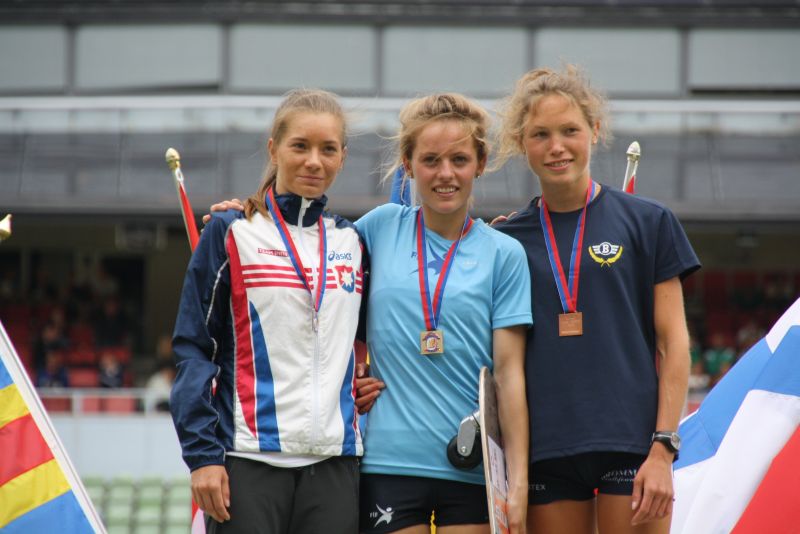
Bjørk at the top of the podium with Emma Dahl and Erika Svanborg.
But yesterday, for the first time, we had a Faroese athlete on the top step! Somewhat unexpectedly, perhaps, because the start list for the 3,000 m steeplechase included a rather formidable woman whom there would have been little chance of beating had she lived up to her entry time. She did not, because she did not turn up for the race. There were also some other withdrawals, so in the end there were only four women at the start. Besides Bjørk, there were two Swedes and one Icelandic woman.
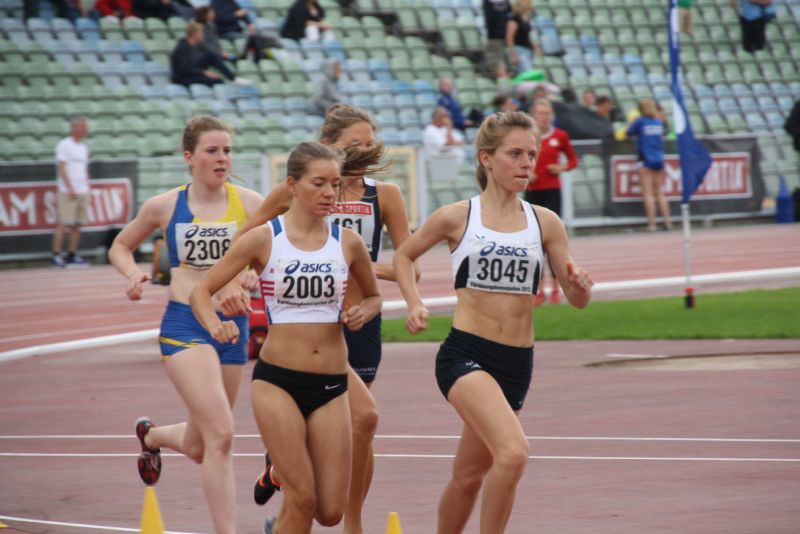
Bjørk was not afraid to take the lead straight away.
The four ran together for the first lap, but already then it was clear that the two at the back were going to fall behind. Bjørk and one of the Swedes, Emma Dahl, who is number four on the Swedish rankings, ran together for the first 1,000 metres, but then a gap began to open between them. Slowly but surely Bjørk pulled further and further away, and after 2,000 metres it looked as if this would be a comfortable win. But with just under 500 metres to go, something happened that sent a chill down the spine of everyone in the Faroese camp. Bjørk fell over a hurdle and went sliding flat along the track. Was this it? Was it all over now? This was not good. But luckily Bjørk was quickly back on her feet and held off the Swede, who had now closed in a good deal and also saw a chance to take the gold.
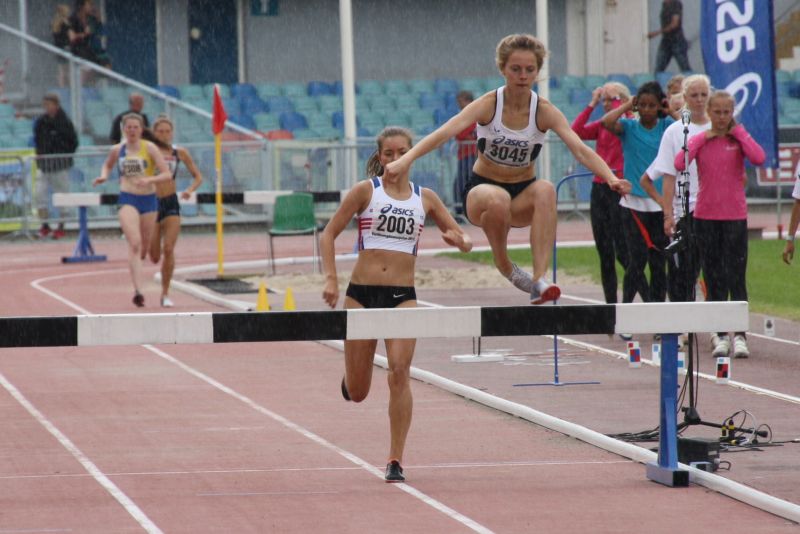
With every lap the hurdles become harder and harder to get over.
When you are that far gone in a steeplechase, it is very difficult to find your rhythm again, while at the same time you become wary of the hurdles. The gap had shrunk from 60 to 30 metres and was still shrinking. 150 metres and the water jump for the last time. We held our breath. Yes, that went well. Only one hurdle left. That went well too. Now all that remained was to sprint to the line for the gold medal. And she managed that in full, in a new Faroese record time – three seconds ahead of the Swede Emma Dahl. The old record of 11:01.90 was improved to 10:55.28.
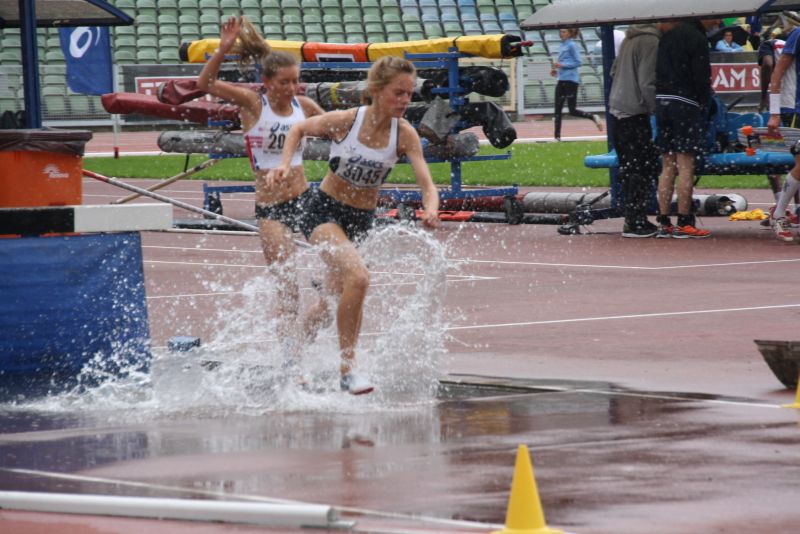
Getting past the water jump can often be a tremendous effort.
This time is not only a Faroese record. It is also the strongest result ever in Faroese athletics, judged by the points in the IAAF scoring tables. In addition, it is a record for the university Bjørk attends. Earlier this summer there was an approach from Denmark, asking Bjørk to represent Denmark at the Nordic U23 Championships in exactly this event. At that time it was the old record – 11:01.90 – that had caught the Danes’ eye. And over the last three years only one Danish woman has run this distance faster than Bjørk.
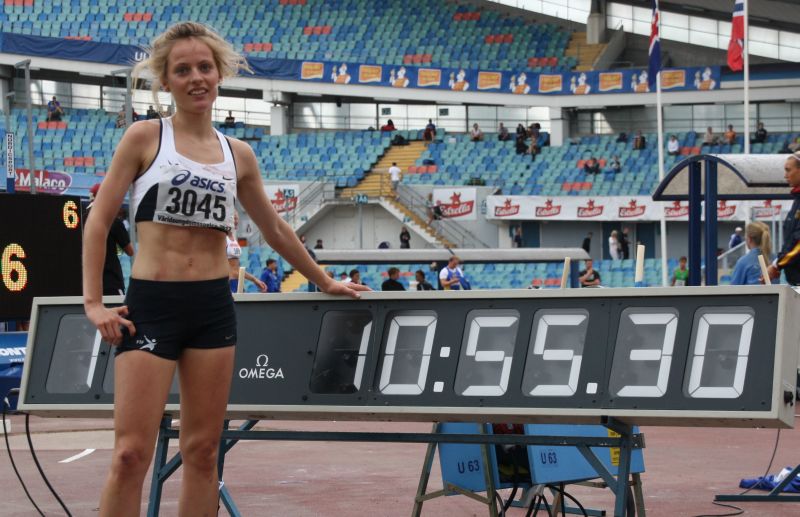
The new record time was corrected to 10:55.28. Wounds from the fall can be seen on her stomach and knee.
In Bjørk we have a steeplechaser of great strength, and there can be little doubt that she will enter this event at the Island Games in Bermuda next summer. The problem, however, is that for this race to be included in the Island Games programme, at least five runners from at least three islands must enter. But if the race does go ahead, it is very likely that one of the three flags beside the podium will be Faroese.
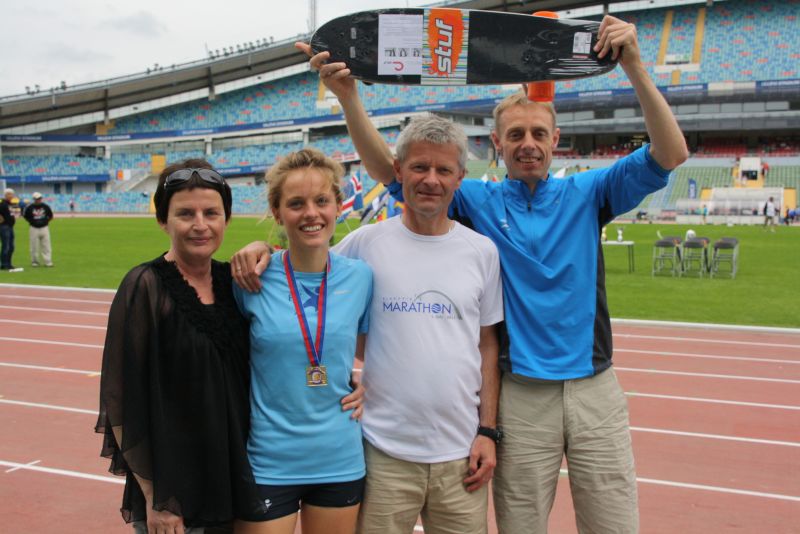
Bjørk with her parents Sunnva and Jósvein and her coach Hallur, who got the skateboard the winner received in addition to the gold medal.