Machine-translated from Faroese and not yet reviewed. Read the original.
The national team came home from Gothenburg with no fewer than four Faroese records. Two of them belonged to Øssur Debes and two to Bjørk Herup Olsen. On top of that, the two very young Sára Debesardóttir and Katarina Høj managed to run the best times ever over 300 and 600 metres respectively. These are not classic Olympic distances, so they do not count as official national records, even though the distances are often used in competition.
The first record came as early as the first afternoon, when Bjørk Herup Olsen ran the 1,500 metres. Her goal was a personal best and with it a new Faroese record, which she had set at this very VU Spelen in 2010, when she ran 4:37.83. The race suited Bjørk’s plans well, and she ended up in a tight field with several other women. The split times were spot on all the way, and with 200 metres to go the time was right around 4:00. By now two were well clear at the front, while the next six were still together in a pack. They then battled their way towards the finish in a long, gruelling sprint. Here Bjørk, who is not otherwise a strong sprinter, managed to hold off two of them, finishing 6th of 21 participants, just a good second off the bronze medal. But the time was good enough for a new Faroese record by half a second, so the record now stands at 4:37.31 min.

A focused Bjørk in 10th place on the first lap. (photo: Jógvan Glerfoss)

A gruelling finishing sprint, and the record was in the bag! (photo: Jógvan Glerfoss)
Bjørk set her second record in the 3,000 m steeplechase, where she also won gold. Read about that race in a separate article here on the site.
One of the old Faroese records fell over the weekend. It is probably not because the 110 m hurdles record is so strong that it has been allowed to stand for so long, but more because this is an event that not many people have tried. And the old record holder, Regin Reinert, was mainly a middle- and long-distance runner with the 3,000 m steeplechase as his speciality. No doubt it was the training from the steeplechase that allowed him to run a time that has, after all, proved hard to beat. Øssur Debes Eiriksfoss had a go last year and was then a full 2 seconds under, but the record could not be ratified then, because it was a hand-timed start.

The warm-up went well…
But now he was going to try again. The opposition was, as you would expect, very strong. But Øssur Debes Eiriksfoss’s only goal was to take the Faroese record from 1994. The gun went, and the athletes leapt fiercely over the first hurdle. All except Øssur. He stuttered his steps so much that he lost 2-3 metres straight away. But from there it went reasonably well, and Øssur crossed the line in a Faroese record time, just under 2 seconds below Regin Reinert’s record. The old record was 19.2 seconds; the new record is 17.38 seconds. In the race against the others, nothing came of it.

The gun has gone, and they have reached the first hurdle….

Even though Øssur is both quick and agile, it takes a lot of specialised training to keep up with those men…..

There is little doubt, though, that with focused training Øssur can take another 2 seconds off his new record. (photo: Jógvan Glerfoss)
Just a few hours later Øssur was due to compete in the triple jump, and again the goal was to set a new Faroese record, ideally over 14 metres, which he has managed indoors this winter. The record, which he holds himself, was set at the Island Games, when he jumped 13.93 metres. Here too Øssur was up against superior opposition. There were three athletes using this competition as their last attempt to achieve the Olympic qualification standard, and since several others were also jumping 15-16 metres, the prospects were that Øssur would only get the first three preliminary jumps, so there was a bit more pressure on the jumps.
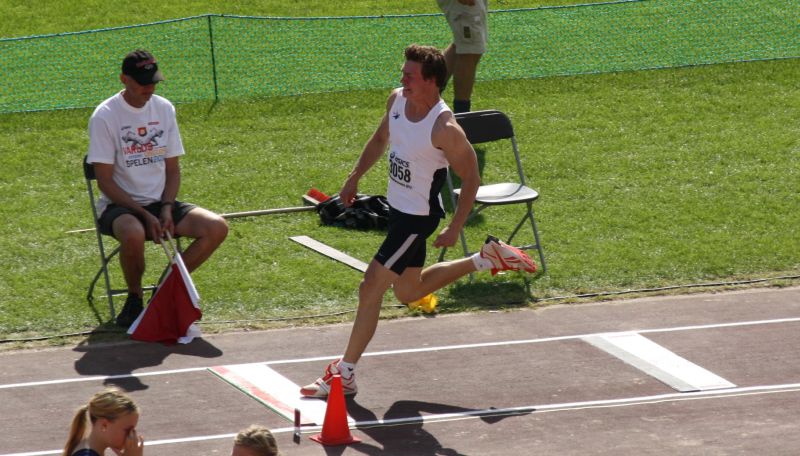
Øssur could have been further onto the board that day. Here it is more or less fine, but on his last and longest jump he was not even on the board, so in reality the jump was about 14.15 metres.
The first jump went wrong and was only about 13.20 metres. The next was a little better, but still a bit short of the record. But when Øssur is competing, you can always expect something special in the final attempt, and so it was this time too. Because in the 3rd attempt he finally managed to reach 13.96 metres, improving the Faroese record by 3 centimetres. Øssur was not entirely satisfied at not getting past 14 metres, but after a long, tiring and hot day, it is not so strange that the last of your strength is not quite there when you need it. It is only a matter of time before Øssur goes well beyond 14 metres.
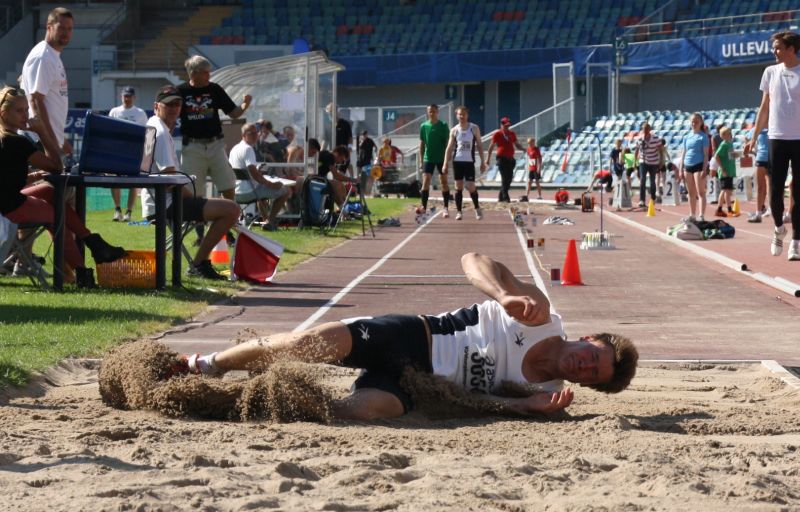
Three valid jumps and a fully legal performance too after a tiring day!
The day before these two competitions, Øssur had also competed in the high jump. Øssur first set a high jump record in 2010, when he jumped 1.76 m. He then set four Faroese records on his way to the bronze medal he won at the last Island Games, which ended with a jump of 1.95 m. At Grand Prix 2 this year Øssur then managed to clear 2.00 metres. On this day there were a great many participants: a few in men’s group B and many in boys 19. As a result there were very long gaps between jumps, and the competition as a whole was also very drawn out. Indeed, the competition lasted almost 3 hours.
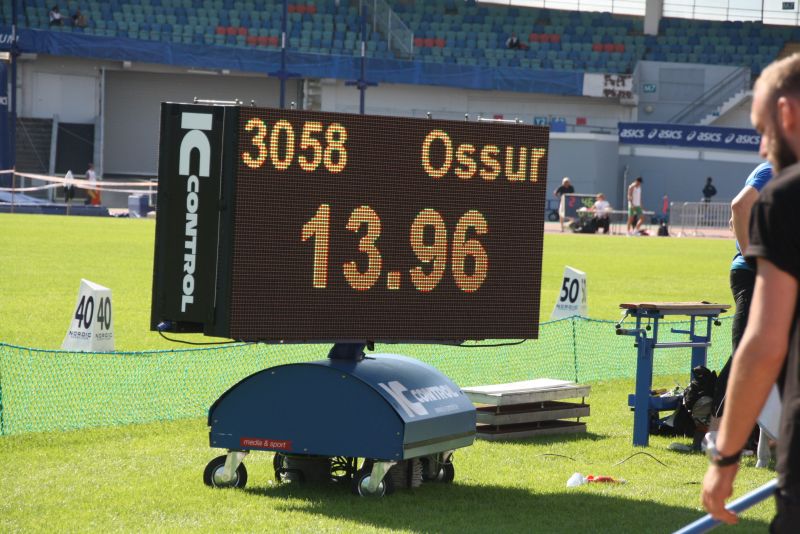
The new Faroese record!
Øssur was probably not having one of his best days, as in several rounds he needed two or even three attempts at each height. At one point he landed so awkwardly on the bar that he got a wound on his back. That only fired him up even more, and in his next attempt he flew over 1.96 m. He cleared 1.98 as well, but now felt so tired that he chose to pass at 2.00 m. He had already cleared that before. So he waited until 2.02 m, where he had the chance to set a new Faroese record. Had he cleared that height, he would also have finished number 2 in this B group. But all three attempts failed, and Øssur finished 4th.

Øssur Debes Eiriksfoss on his way over the bar. Not a Faroese record in this round, but 1.98 m is something to be proud of too!
There are many very young girls coming through who are wiping out most of the age-group records set by Rebekka Fuglø and Bjørk Herup Olsen. On Sunday Sára Debesardóttir ran the 300 m in the girls 15 category. Sára is only 14, and finished mid-table in a huge field of 80-90 participants. Elsa Berg held the girls 14 age-group record, which was 46.68 seconds. The goal was to take this age-group record, and it must be said that it went brilliantly. Because when Sára crossed the finish line, the clock showed 44.60 seconds. And that is indeed also the fastest 300 metre time any Faroese woman has ever run! Incredibly fine and impressive by Sára, who is only 14 years old.

Sára Debesardóttir (in white) sets off in the 800 metres.
So it was also very exciting to see how much she had improved over 800 metres, which was on Monday. Sára was seeded roughly in the middle and ran in heat 3 of the five heats. This was an unfortunate heat to end up in. The leading girl was very fast and set off hard, while some tried to hang on behind. Even though Sára had a (too) fast split at 200 metres, she was towards the back. Up to 400 metres she then made up most of the ground. This was hard work, and it took its toll on the second 400 metres. Not only for Sára, but for everyone else too. Sára fought well and finished 3rd in the heat with a personal best of 2:30.25 min. Overall she finished 14th of 48 participants.

Sára and her father, Debes Christiansen, who is also her coach. This is just before the 300 m start (photo: Jógvan Glerfoss)
And we have one more great talent in the talent group. Katarina Høj looks set to devour every single age-group record she comes across. On Sunday she ran a superb 200 m (girls 13) and took a whole 81/100 off her own record, which she set in Tårnby in May! The time was 29.21, which was good enough for 48th place of 89 participants.

Katarina Høj (in the middle) strains as she crosses the finish line in the 200 metres with a new girls 13 age-group record.
As mentioned, Katarina has already taken many age-group records, but one of those we had expected to stand, if not forever, then for a very long time, also fell on Monday. In 2006 Rebekka Fuglø ran the 600 metres in 1:44.44, which earned her a bronze medal at the time. We had hoped Katarina might be able to compete for a medal. In any case she had a chance of beating Rebekka’s time. Katarina ran in the A final, but the leaders were in a class of their own and set off at blistering speed. Katarina sensibly ran her own pace all the way, and in the sprint was able to run herself up to 5th place of the 37 runners! And the time was a new age-group record by 24/100. 1:44.20 min is also the best 600 metres ever run by a Faroese woman, which promises a very exciting future for 13-year-old Katarina Høj!

A very strong Katarina sprints to the finish, running the best Faroese time ever over 600 metres.