Machine-translated from Faroese and not yet reviewed. Read the original.
If the first day in Reykjavík was good, the second was perhaps even better. By the end of the day, two athletes had achieved the Island Games qualification standard, four gold, two silver and three bronze medals had been secured, and three new indoor records had been set.
The biggest moment from a Faroese point of view was probably when Trygvi Laksafoss, on his third and final attempt in the high jump, went for 1.85 m. Just before that he had secured the gold with 1.77 m, which he cleared on his second attempt. As the last man left in the competition, he could choose the next height, and he chose to have the bar set at 1.85 m, matching the Island Games standard. His highest jump ever had been 1.79 m! His first two attempts failed, but on the third he went over. The bar wobbled for a moment, but then stayed put. Trygvi had won gold, set a big personal best and, last but not least, achieved the Island Games standard.

Trygvi Laksafoss won gold and achieved the Island Games standard, which was 1.85 m. Here he clears 1.77.
It was also a big moment when birthday boy Marnar Djurhuus lined up for the 1,500 m. Marnar is by far our best distance runner, but had not yet achieved the Island Games standard of 4:09. If he managed that, he would also break Bogi Lenvig’s old record of 4:10. And it turned out to be a good race for Marnar, ending in an exciting sprint finish in which he had to settle for the silver medal. But Marnar probably didn’t take that too hard, as this was a great result. With 4:06.41 min he was three seconds under the Island Games standard and four seconds under the Faroese record. So this was also a big (birth)day for Marnar.
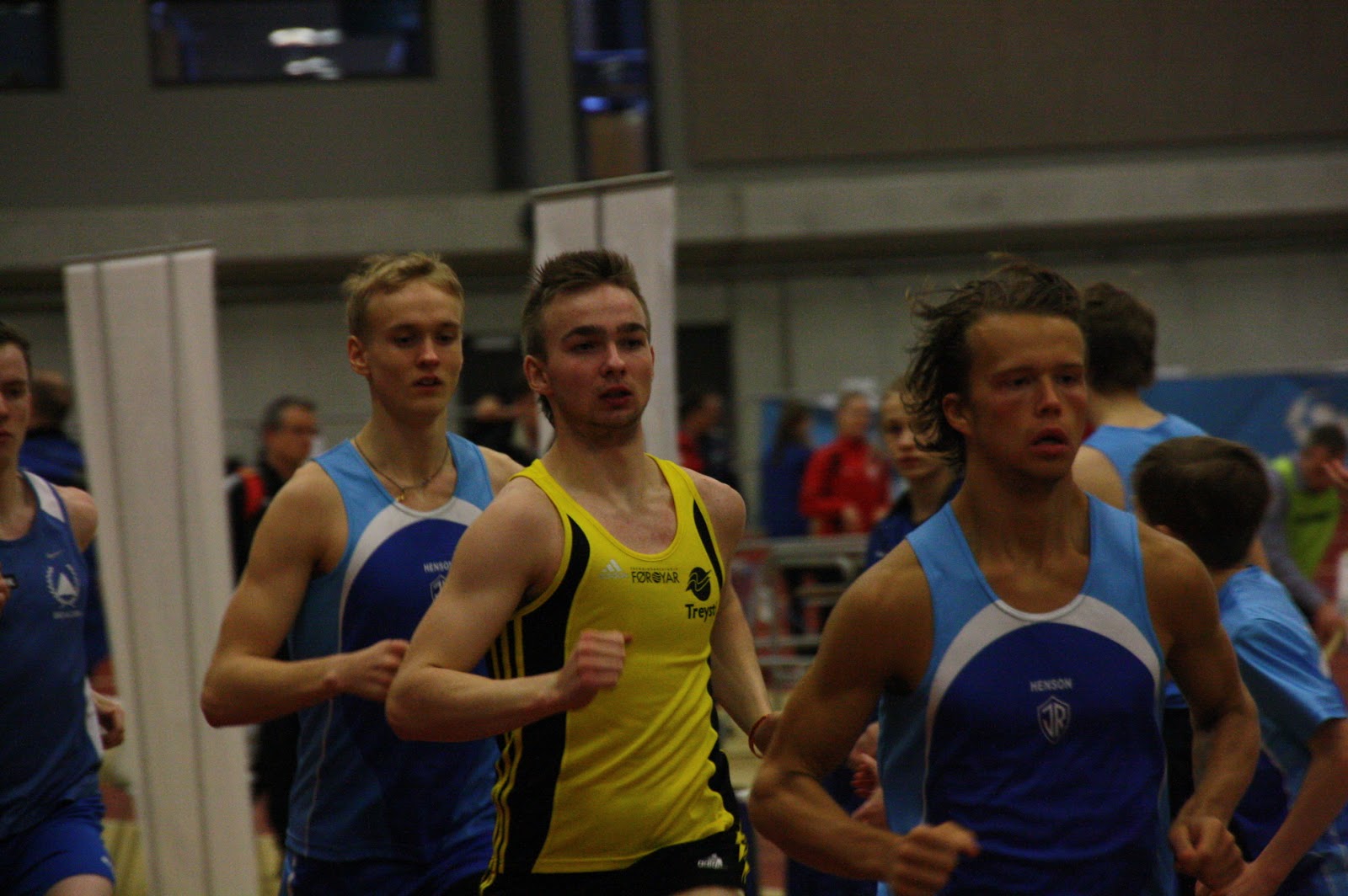
Marnar Djurhuus achieved the Island Games standard in the 1,500 m when he took silver in a time of 4:06.41 min, which is a new indoor record (photo: Gutti)
One of the most exciting moments of the day was the 800 metres for girls aged 14. Two girls quickly established a clear lead at the front, and one of them was Bragdið’s great talent Katarina Høj. For almost the entire last lap they were dead level, and they came towards the finish side by side. Crossing the finish line they were still so level that neither the human eye nor camera lenses measuring to 1/100 of a second could separate them. So this exciting race ended with both being declared gold medallists.
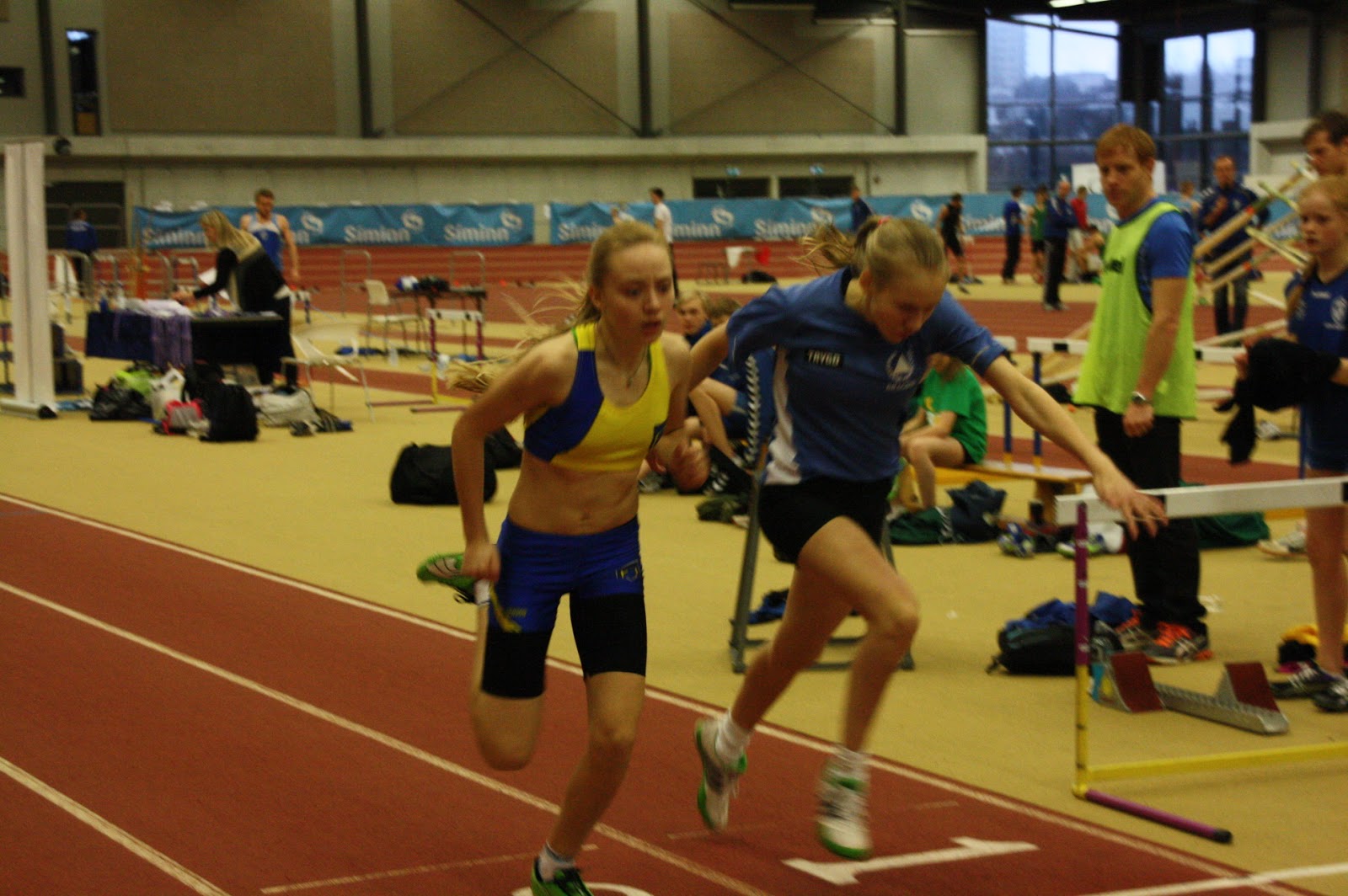
Katarina Høj and the Icelandic girl crossed the finish line dead level in the 800 m (photo: Gutti)
Teitur Bjarnastein of Bragdið won no fewer than three medals at the meet, two of them gold and one silver. On Saturday he won gold in the 800 metres, and on Sunday he left the whole field far behind in the 1,500 metres. He was a full 14 seconds ahead when he crossed the finish line. In this race Hanus Jóhansson of Hvirlan managed to win bronze. Teitur was not quite finished yet, though, as he also showed his quality in the 400 metres, winning a comfortable silver medal.

Hanus Jóhansson of Hvirlan won bronze in the 1,500 m for boys aged 16-17. (photo: Hvirlan)
Teitur was not the only one to win two gold medals, however. Rebekka Fuglø did so too. On Saturday she won the 800 m, and on Sunday she also won gold in the 1,500, even though she was not at her best. Rebekka finished the day with the 400 m, but here she had to settle for 5th place.
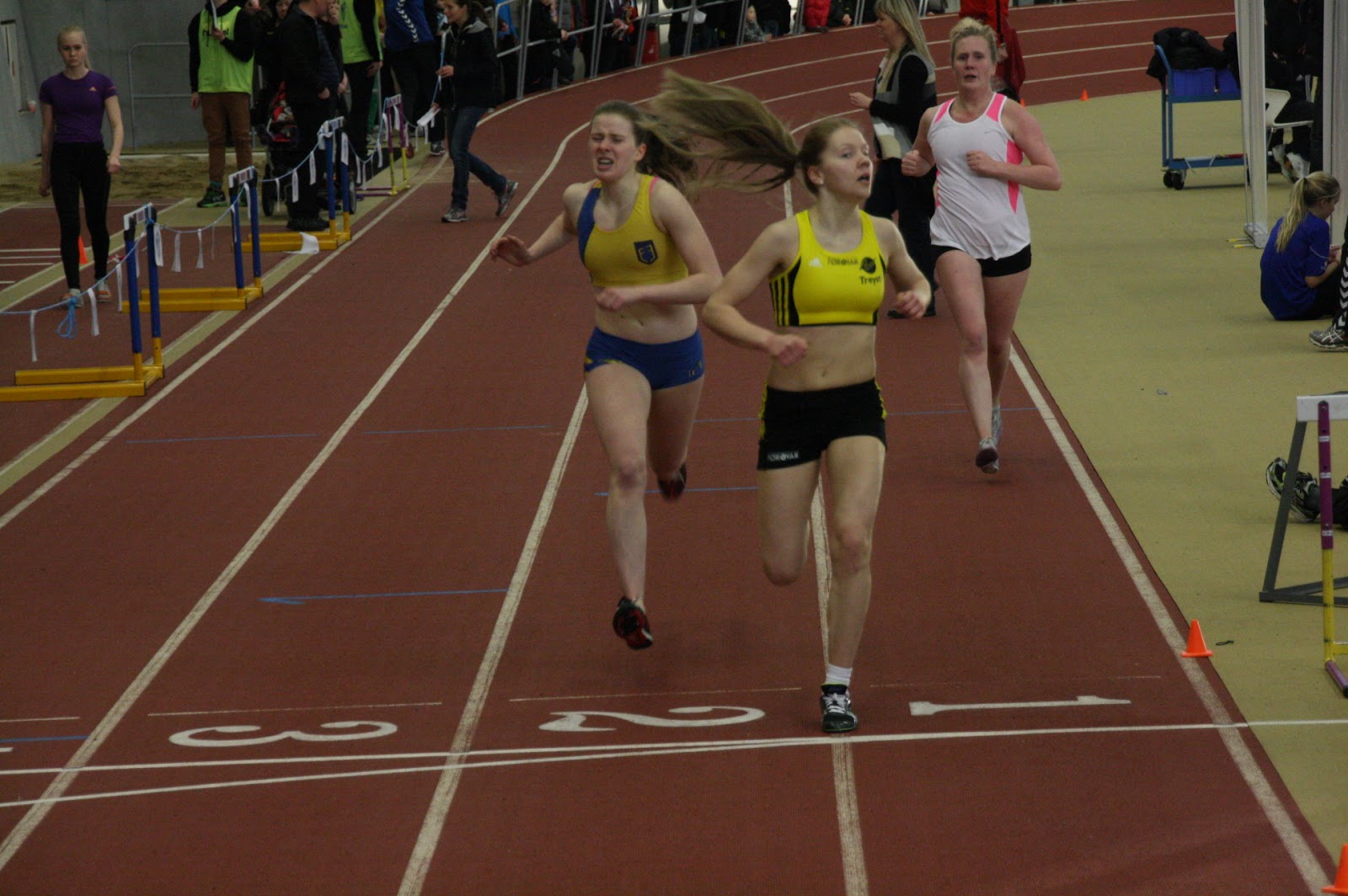
Rebekka Fuglø won gold in the 1,500 m after an exciting sprint finish (photo: Gutti)
And there were also bronze medals for two very hard-working ’98s. Tórur Mortensen of Hvirlan started Sunday morning with the triple jump, where his first jump was his best of six, 10.61 m. This was the second-best jump in the first round, and going into the sixth round Tórur was still in second place. But in the very last round an Icelander managed to jump further and snatch the silver medal from Tórur, who could nonetheless be pleased to step onto the podium with a well-deserved bronze medal.
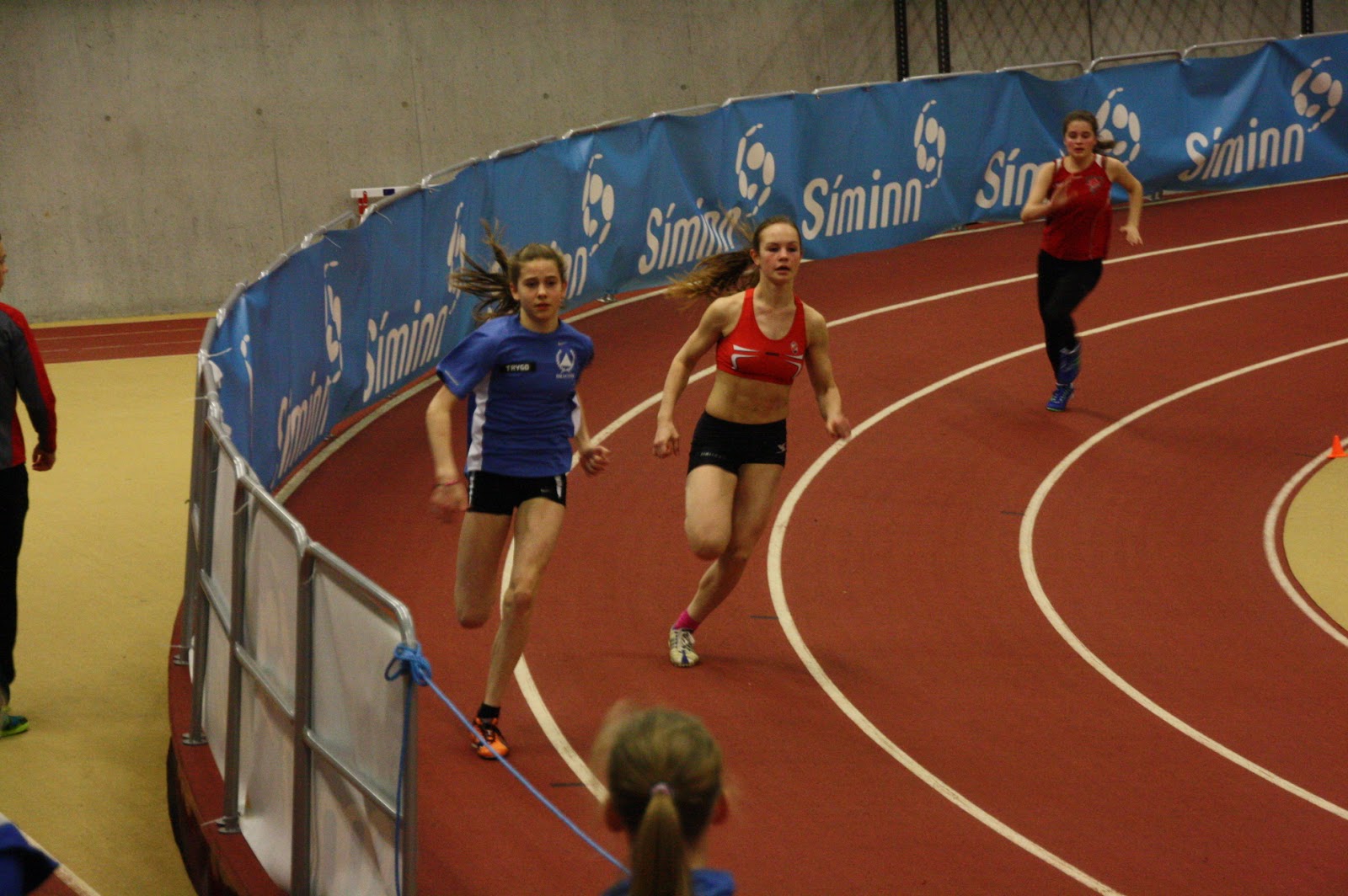
Sára Debesardóttir won a bronze medal in the 400 m (photo: Gutti)
Sára Debesardóttir, Bragdið, also won a bronze on Sunday. This came when she had to settle for third place in a very exciting race. The top three all finished within 7/10 of a second. Sára’s time was 64.95 seconds, and only Rebekka Fuglø has run faster than this.

Tórur Mortensen won bronze in the triple jump for Boys 15. (photo: Hvirlan)
Three new Faroese indoor records were also set on Sunday. Marita K. Petersen of Hvirlan, who took the long jump record on Saturday, was not quite finished. Only two of her six jumps were valid, but the second of them was more than enough for a new Faroese record, 9.46 m. The old record of 9.24 m was held by Edna Maria Debes. The 60 metres hurdles record also fell that day. Helgi Geyti of Hvirlan saw to that, improving his own record by almost one and a half seconds!! The new record is 10.54 seconds. The third record of the day was the previously mentioned record by Marnar Djurhuus, Treysti, in the 1,500 m.

Marita K. Petersen now holds all the jumps records – long jump, high jump and triple jump! (photo: Hvirlan)
A tally by Regin Reinert, who keeps all our records up to date, shows that around 60 new age-group records were set this weekend. And as he says, it will probably be a long time before so many records are set again in such a short time. This is because in several cases there was no record beforehand, which comes from the fact that it is fairly new for Faroese young people to compete indoors. But my hope is that the clubs keep giving their athletes the opportunity to compete indoors in the depths of winter, because without such a carrot the dark, cold and wet winter becomes even longer. Nor does it hurt to show our big brother to the west now and then what we are capable of. And the Icelanders certainly don’t begrudge us the 9 gold, 4 silver and 4 bronze medals that our athletes brought home.