
Machine-translated from Faroese and not yet reviewed. Read the original.
The medal haul is growing at a rapid pace, and tonight both the fifth and sixth medals went into the bag. They were bronze medals for Rógvi Højgaard in the javelin and for Marnar Djurhuus in the 5,000 metres. All three of our finalists were competing at the same time, as Trygvi Laksafoss was also in action in the long jump final during this intense spell.
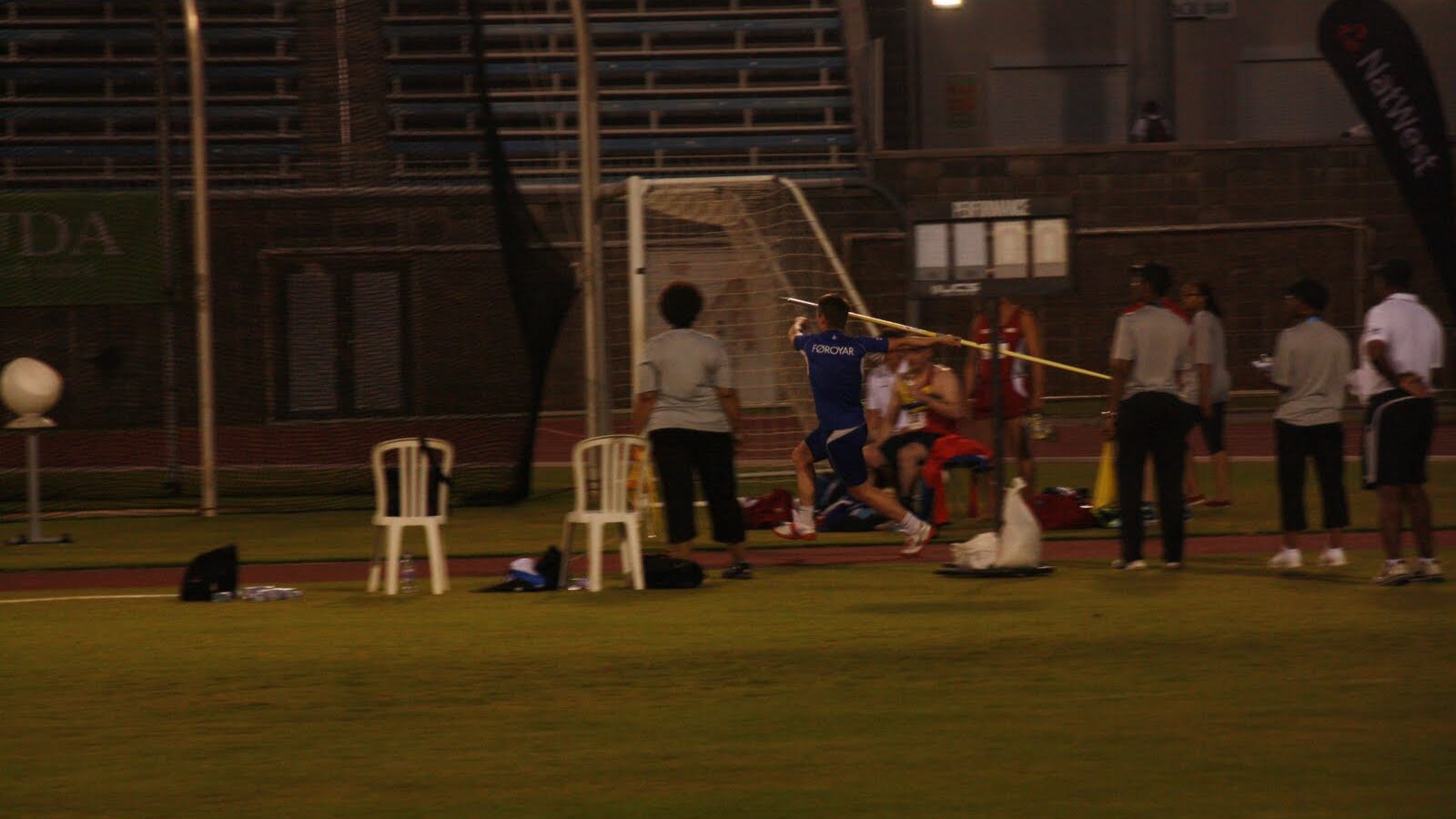
After the first round, Rógvi Højgaard sat in third place among the seven javelin throwers with a throw just under 53 metres. That was far from safe, as an Orcadian was right behind him. In his third attempt Rógvi managed to improve to 54.05 metres, which also turned out to be his final result. But it was a very tense Rógvi who watched the Orcadian throw the last rounds. Luckily for Rógvi and the Faroe Islands, the Orcadian failed to improve, and Rógvi’s first Island Games medal was a reality. First and second place were never within reach. An athlete from the Cayman Islands set an Island Games record of 70.66 m in his first attempt, and the old record holder threw over 62 m.

Rógvi builds up speed. This throw landed at 53.66 m.
The Faroese have built up something of a tradition in the javelin at the Island Games. Rógvi is in fact the third Faroese athlete to win a medal. The other two were Líggjast Høgnesen, who won silver in the Faroe Islands in 1989, and Heini Hansusarson, who won bronze in 2003. In 1995 Jørgen Meitilberg missed out on a bronze medal by just 12 cm, and today Hanus Bergsson is waiting impatiently on the sidelines, eager for the next Island Games, when it is very likely that he will be part of the Island Games team.

At last the bronze medal Rógvi has waited so long for arrived. With it he is keeping the Faroese javelin tradition alive.
The other technical event running at the same time as the javelin competition was the men’s long jump, where we had Trygvi Laksafoss among the six participants. In the long jump it is practically impossible to win a medal, because the Morgan twins from the Cayman Islands have a patent on it. Today Carl jumped 7.46 m while Carlos jumped 7.45. They must be identical twins. And just 13 cm off gold came Bruce DeGrilla with 7.33 metres, so there was not much to be done there.
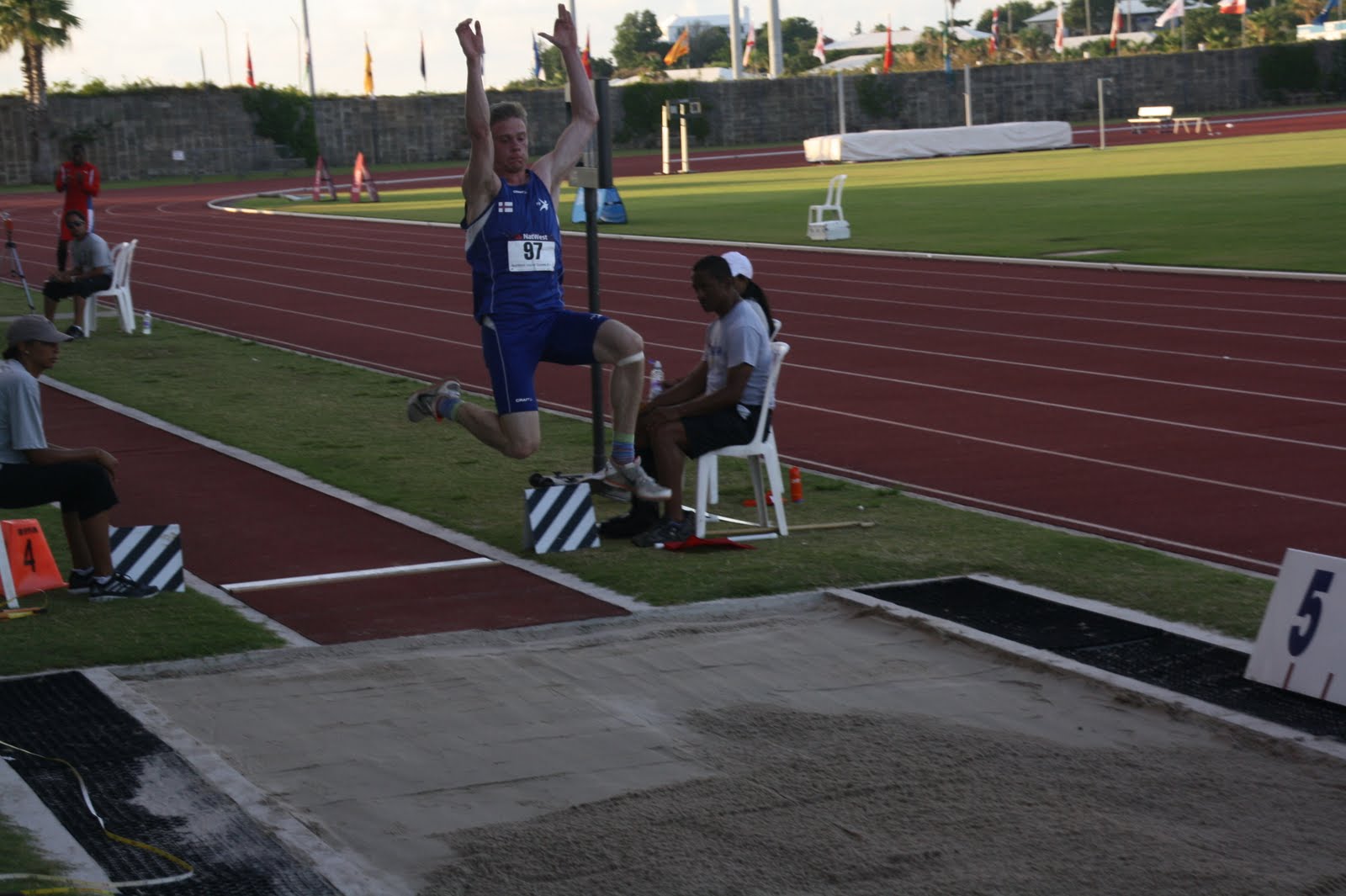
Trygvi, pedalling in mid-air.
Trygvi’s goal was to jump over 6 metres, and preferably over 6.02, which is his personal best. Trygvi’s jumps were consistently good, but he fell a little short of reaching his target. Trygvi’s longest jump was 5.74 metres. All of Trygvi’s jumps were valid, and the shortest was almost as long as the longest.

Trygvi Laksafoss was not entirely satisfied, but he will come back strong in two years’ time!
Tonight Marnar Djurhuus was also out to defend the bronze medal he won in the 5,000 metres two years ago. A close read of the start list showed that this would not be entirely impossible. On our way down to the track we happened to walk alongside the Orcadian who won silver in the 10,000 metres, and who was our favourite to win the 5,000 metres. He told us that he was not going to run, but planned to save all his strength for the ½ marathon. Now the situation was suddenly completely different, because we now knew that none of the others could probably set such a hard pace that Marnar could not hang on for most of the distance. Marnar also has a very good finishing kick, so in reality the battle for the medals was wide open.
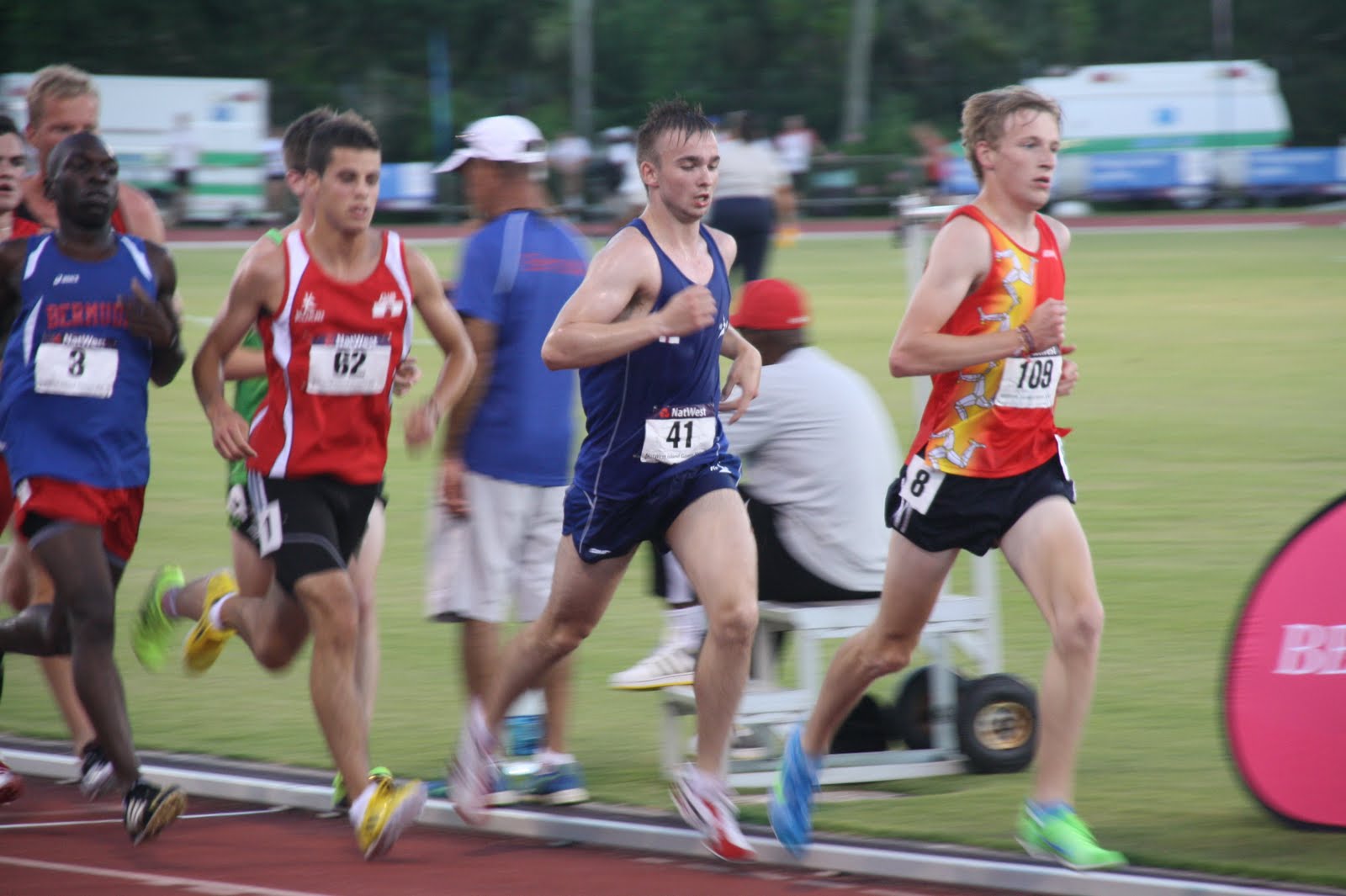
This is how the picture looked for large parts of the race.
The race went exactly as expected. Oliver Lockley of the Isle of Man, who finished 4th in the 10,000 m, went to the front and held an even pace of around 3:10 per km. That is how it went right up until about 500 metres remained, when lolo Hughes of Ynos Mon suddenly made his move, intending to settle it all in one long sprint. Marnar and Lockley tried to hang on, but Hughes, who had been completely invisible throughout the race, had timed his run perfectly. Lockley chased to the bitter end but never caught Hughes. Marnar gave up the chase with 200 metres to go, but was safe in bronze with 15:46.70 – just one second off his best time, but 10 seconds faster than at the last Island Games.

Rógvi and Marnar – two happy and proud medal winners. Heartfelt congratulations!
The very latest from Bermuda is that Rebekka Fuglø, with 2:17 min, has comfortably secured her place in the women’s 800 m final. This was her second-best time ever, and would have been a Faroese record just three weeks ago. But it looked effortless for Rebekka, so the final will be very exciting, as the field there otherwise resembles one of the biggest powder kegs of the Island Games.


