
Machine-translated from Faroese and not yet reviewed. Read the original.
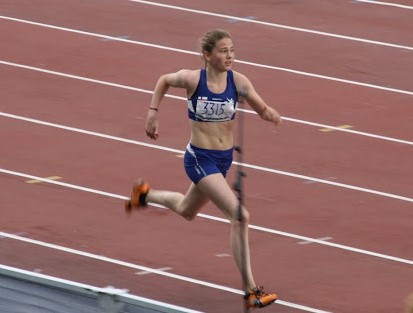
On Sunday the Faroese athletes again won a host of medals as the second day of Stórmót IR took place. The most unexpected result probably came from Sára Debesardóttir, who finished far ahead of the field in the girls’ 16–17 400 metres. The clock showed 61.48 seconds, which was also enough to set the next Faroese indoor record of the meet. Once again it was a fairly old record held by Rebekka Fuglø from 2009 that fell. Sára Debesardóttir has had a real breakthrough these past few days, and is now very close to meeting the Island Games qualification standards in both the 200 and 400 metres, which have otherwise been tightened considerably. The weekend gave Sára a gold medal, a bronze medal, two Faroese records and an exciting summer ahead.
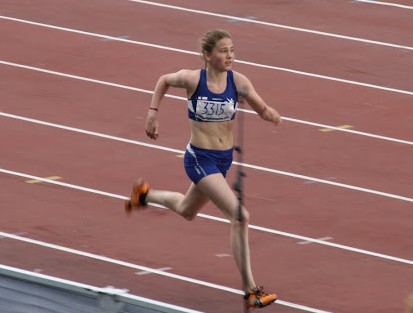
Sára Debesardóttir set two new Faroese indoor records over the weekend. Pictured here in Gothenburg last summer. (photo: Guttorm Sørensen)
It was a pleasure to update the women’s indoor records. We so often complain that we have so few good sprinters in the Faroe Islands. But in 2014 new records have already been set at 60, 200, 400 and 800 metres – at 60 metres even twice! Things are moving forward!
There was no medal for Rúni Seloy when he ran the 400 m in the men’s race. And although he was not entirely satisfied himself, he ran a new Faroese record with a time of 52.08 sec. He held the old record himself.
Several more medals were brought home on Sunday. Gunnar Sivertsen won gold comfortably in the 1,500 metres for boys up to 17. With 4:52.85 min he left his only opponent far behind. Gold also went to Steintór Egholm from Bragdið, who won the boys’ 14 800 m with a very good sprint finish. With a time of 2:24.84 he finished a little under half a second ahead of the next runner. Steintór has not yet been training for a year, and this was his first competition abroad. Tórur Mortensen, Hvirlan, did not quite jump to his best in the triple jump, but still comfortably won silver with 11.56 m. Tórur competes in the 16–17 age group. Rebekka Fuglø had intended to run a little faster than 4:52.8 min in the 1,500 metres. But no doubt the tough 800 m on Saturday had taken its toll. Even so, it was enough for Rebekka to win silver. The gold medallist here was Iceland’s world star, Anita Hinriksdóttir, who set an Icelandic record with 4:19.31 min.

Tórur Mortensen won silver in the triple jump. But he is perhaps just as pleased with his good result in the long jump (5.45 m) – (photo: Hvirlan)
Steingrímur Hallsson, Bragdið, who won bronze in the 800 m on Saturday, repeated the feat in the 400 m on Sunday. Although he was in the slower heat, he managed to run his way to third place overall. His result was 55.27 seconds and a big personal best. As with Steintór, this was the first competition abroad for Niklas Kruse from Bragdið. Niklas comes from Sundalagið, but attends the football class at Kommunuskúlin. So it is convenient to train athletics in Tórshavn after school. And it is paying off, as he won bronze in the boys’ 15 400 m. Although he went out a little too cautiously, he got down to 61.54 seconds. After two gruelling 3,000 metres this weekend and last, there was not much left in the tank for Marnar Djurhuus when he tackled the 1,500 metres on Sunday. With a time of 4:12.71 min – 6 seconds slower than last year, when he set a Faroese record – he nevertheless managed to run his way to a bronze medal.

Niklas Kruse is an exciting new name in athletics. He is not entirely new, though, as a young boy he won a host of local fun runs (photo: Bragdið)
The Faroese athletes have run many other good races besides those mentioned here, and all the training this winter really seems to have paid off. Age-group records and personal bests have been set in large numbers over these two days. Stórmót IR is a welcome competition in many ways, and it is no surprise that the three clubs, Bragdið, Hvirlan and Treysti, have embraced it. Stórmót IR is a great bright spot in a dark winter. Both in sporting terms, and not least socially, it has almost become an essential event that brings together both teammates and rivals.
It would be nice if we in the Faroe Islands had an indoor arena where we could invite the Icelanders over our way to compete.

This is not from the Paralympics. No, this is Tummas Napoleon Arge, who showed exemplary competitive spirit. Despite a broken arm in plaster, he wanted to compete. (photo: Hvirlan)


You must be logged in to post a comment.