
Machine-translated from Faroese and not yet reviewed. Read the original.
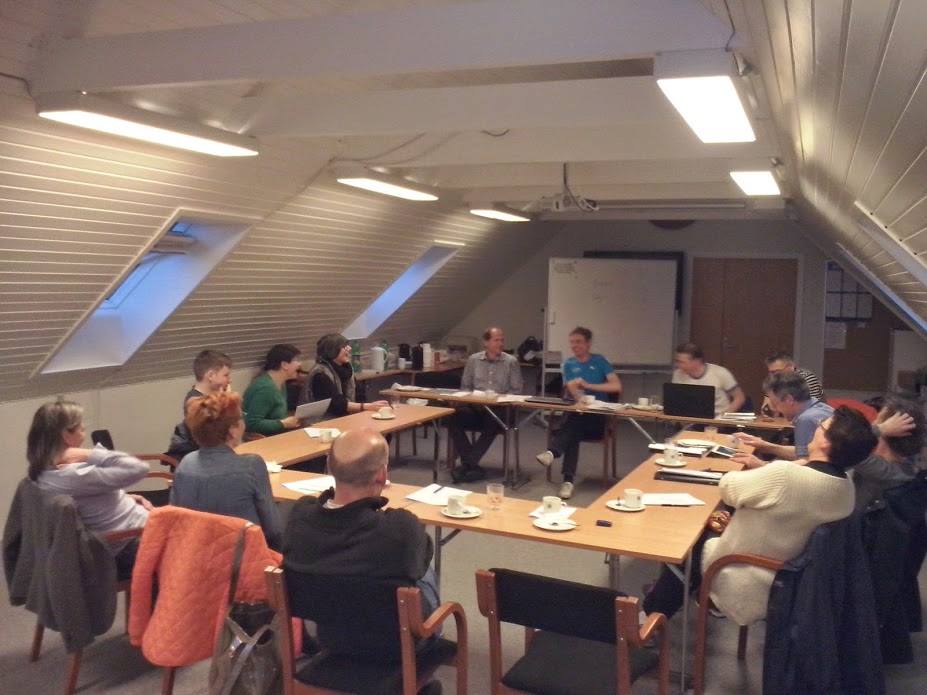
On Wednesday evening 20 April, FÍF’s annual general meeting was held in the meeting room at the ÍSF building. Attendance was excellent. People came to the meeting from near and far. That Wednesday evening people came from Norðoyggjar, Eysturoy, Suðuroy and Vágar, and for the first time all the clubs under FÍF were represented at the general meeting. We are naturally pleased about this, and we are also pleased that the number of people attending was the highest ever.
Some of those attending were held up by blasting work on the main road below Gøtueiði, so the clock had gone somewhat past the scheduled time before the chair welcomed everyone. Niels Jákup Jakobsen was nominated as chair of the meeting, which was well received. Niels Jákup handed the floor back to the chair for the chair’s report, and most of it can be read at the bottom of this article.
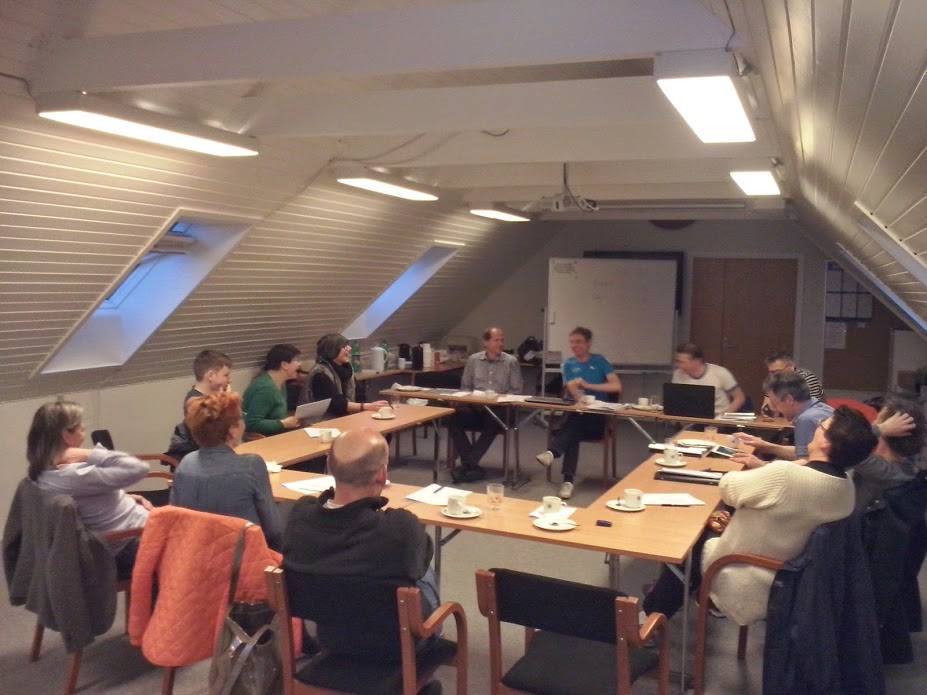
After the general meeting had approved first the annual report and then the annual accounts, which Guttorm Sørensen presented, the board election was on the agenda. The chair was up for election and had announced that he would stand for re-election. There was no opposing candidate, so all that remained was to applaud two more years. The same applied to Guttorm Sørensen. Heini Hátún was also up for election and did not stand again. Regin Thomsen and Rigmor N. Arge stood, and the vote gave them three votes each. A new vote was then held, and this time Rigmor got four votes, while Regin got two. Rigmor is therefore newly elected to the board.
A competitions committee was also elected. The previous committee of Hallur Holm, Guttorm Sørensen and Tummas Napoleon Arge continues, but will also be strengthened by Regin Thomsen.
One motion had been submitted. Hvirlan had some questions and some requests regarding the travel cards with Strandferðslan. There was a long debate about the importance, the possibilities and not least the limitations of this scheme.
After that came any other business. Here the chair first gave information about the report on the new support scheme for elite athletes, and later about the planned structural changes in ÍSF, which among other things mean that clubs will no longer have voting rights at ÍSF’s general meeting. There was also a lengthy discussion about how competitions are announced if they are to have approved results and approved qualifying standards from FÍF.
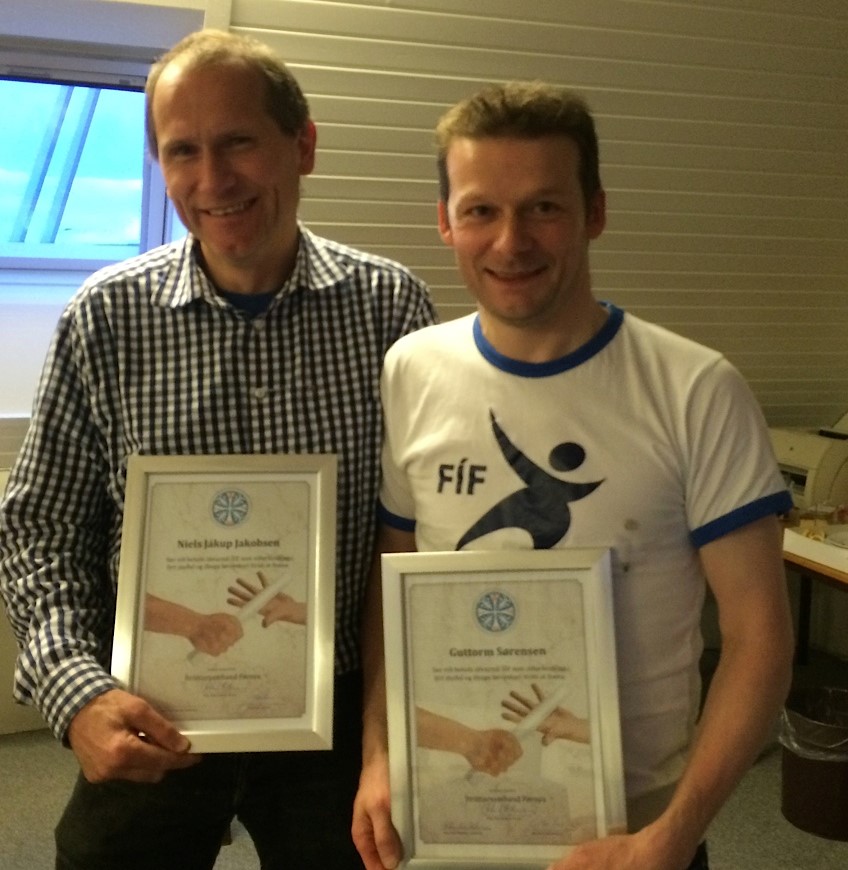
Board members who have sat on the board of a federation for five years receive ÍSF’s silver pin. Niels Jákup Jakobsen and Guttorm Sørensen have sat on the FÍF board since its founding day in 2002, and should therefore have received this honour a long time ago. But it was done at the general meeting, and they have both thoroughly earned this honour.
The chair’s report 2014
—-
When the treasurer presents the accounts after the chair’s report, he will show a large deficit. This should not, however, in any way be seen as something bad. Firstly, FÍF had the money, and secondly, new income greater than the deficit is already on the books for 2014. The treasurer will explain this.
The large deficit is of course positive, because it is proof of greatly increased activity. 2013 was a year in which both the Island Games squad and the talent squad were larger than in previous years.
And in sporting terms 2013 was also a very good year. At the Island Games in Bermuda we won two gold medals, two silver medals and four bronze medals, and finished seventh overall in athletics. That things are going in the right direction is confirmed by the fact that at the last two Island Games we have won 13 medals, whereas at the three Island Games before that we won only two medals in total.
For many years we have had strong women in distance running, and in 2013 one more came along. Valborg Heinesen was the first Faroese woman ever to win a gold medal in athletics at the Island Games. And she won both the 10,000 m and the half marathon. Øssur D. Eiriksfoss was at the Island Games as a gymnast, but also competed in athletics. Here he set Faroese records in both the high jump and the triple jump, and in both cases it was enough to win silver. Marnar Djurhuus won bronze in both the 10,000 m and the 5,000 m. The other two bronze medals went to Heri Ziska in the discus and Rógvi Højgaard in the javelin.
That development among young athletes is moving quickly can be seen especially in the last two named. Heri and Rógvi have each sat on their own throwing throne for many years. But at the Faroese Championships Hallur Simonsen beat Heri, while Rógvi only just managed to stay ahead of Hanus Bergsson. Hanus has, however, this spring thrown beyond the Island Games standard and is closing in on the Faroese record. Hallur and Hanus will probably be at the next Island Games, where they will no doubt compete among the very best.
Katarina Høj also stepped into the senior ranks when she quite unexpectedly set a personal best by 10 seconds at VU-Spelen in Gothenburg. And with it a new Faroese record. This only stood for one day, however, because the next day Rebekka Fuglø took back the record she had held before. Rebekka has since improved it twice, and this is also part of her 10 outdoor records in 2013, during which, among other things, she was just a pace and a half from winning bronze at the Island Games, but unfortunately fell.
We also got a whole host of youth records last year, and it is a pleasure to make updates on the website. The keen eye will also notice that the children’s and youth records held by our older young athletes are being broken, almost every single one. And we are pleased about that.
2014 has also started unusually well. At RIG, Stórmót and the Danish Indoor Championships we got new records in the 60 m, 200 m, 400 m and 800 m for women and in the 400 m, 1,500 m and 3,000 m for men. Sára Debesardóttir and Rebekka Fuglø set the women’s records, and Rúni Seloy and Marnar Djurhuus the men’s records.
And road running has also gone brilliantly. First Valborg set a new Faroese record over 15 km, and at the World Half Marathon Championships in Copenhagen we got new records for both women and men. Valborg cut more than three minutes off her old record, while Marnar took the 28-year-old record, the second oldest of all, when he cut just under a minute off Absalon Hansen’s record. It is also worth noting that Bjørk Herup Olsen also came in under the old record that day, and she is on her way back after both injury and illness.
With the chip technology used in Copenhagen, it can also be seen that Valborg’s and Marnar’s results were also good enough to take the 20 km records. It is currently being investigated whether these records can be ratified.
At the end of June we are going back to VU-Spelen in Gothenburg with the A squad and the talent squad. We have not, as usual, yet had training camps for the whole group. Only one camp has been held. This was for middle- and long-distance runners, and 20 runners spent a weekend in April in Klaksvík, where as usual we stayed at the Scout houses. The training camp for the whole group is planned for 16–17 May.
Cooperation
It is very important that FÍF and the clubs can cooperate on matters within athletics. There have been various issues on and around Tórsbreyt that have needed improvement, and various equipment is also missing at Tórsbreyt. FÍF, together with board members and coaches from Bragdið and Hvirlan, has discussed what should be done and what can be demanded. We have since been at a meeting together with the Culture Department, which showed a very good willingness to cooperate. Some things have fallen into place, but some are still outstanding. Next Monday there will again be a meeting with the City Council, and hopefully more things will fall into place then.
When it was announced in the autumn that Tórshavn City Council had now decided to build a multi-purpose hall out on Landavegur, Randi Kúrberg got in touch with Bragdið and FÍF, and a meeting was quickly arranged. We made a proposal for how athletics could become part of such a building, and got a meeting with the political authorities, who looked positively on the proposal.
The plans for Landavegur have since been dropped, and the plan is now to build an extension to the Gundadalur hall. Training conditions in the winter months are so poor that any improvement helps. A letter has therefore again been sent to the City Council requesting a meeting, where we want to hear what plans they have and how athletics can become part of this project.
When clubs and the federation cooperate on such matters, it gives much greater weight and clout, and can no doubt also be used in other cases by other clubs.
Icelandic cooperation
The many Faroese visits to Iceland can be said to have had an effect. The chair of the Icelandic athletics federation, Jónas Egilsson, has offered to send Icelandic course leaders to run an IAAF coaching course in the Faroe Islands. These are lengthy courses, taking two weekends plus three weekday evenings in between. He has also offered to come here to run courses for officials. This is very interesting, because the officials’ certificates we got in 2010 expire next spring. This means that in any case we must hold a course for officials by next spring at the latest. First, however, it must be checked whether Dansk Atletik Forbund will accept us taking Icelandic officials’ certificates. Otherwise it will be DAF that comes to hold the course.
We are also cooperating with the Icelanders on a statistics database. Fríðrikur Oskarsson from FRI is currently working on a new system, in which he plans to create a separate section for Faroese results. The reason he wants to do this is that it is a pilot project for him. An attempt to get a new system up and running that can be sold to all federations or clubs that wish to record results.
International cooperation
Having a good friend is important. Because now the time has come to speed up the work of gaining international recognition for the Faroe Islands in athletics. We have reached the point where we are allowed to take part in Nordic Championships. The next step is to get Iceland and Denmark to win us the right to take part in the annual Nordic meeting – with observer status to begin with. Here we must then plead our case and win support from all the Nordic countries as well as from the Baltic countries, which also take part in various Nordic Championships.
ÍSF’s elite policy
ÍSF has come out with a new report with rules and procedures for distributing the elite funding. The scheme is divided into three groups, with 85% of the money distributed in Group 1. To even be considered for Group 1, the federation concerned must have international recognition.
The smaller clubs
I think that in all my chair’s reports I have had a section I call “the smaller clubs”, and so it is again this year. Last year we were pleased about the revived Roysnið, and since then Roysnið has risen even further. Now in April Regin Thomsen has started running training for young people at Svangaskarð, which is very pleasing. Hopefully this will be seen on the track this summer, and hopefully, and as expected, this will also be the last time I mention Teir Grønu in this section.
In Suðuroy too, there seems to be more life again at Hvistan, after things had cooled off a little a year ago. Poul Dam is back in action in Tvøroyri, and the chairwoman, Osla Christensen, has held regular training sessions in Hvalba. In addition, Finn Johannesen has built up a good group of recreational runners in the southern half of the island.
Frælsi also offers regular training with Susan Tausen and Laila Jacobsen. This winter we have seen that both Frælsi and Hvistan are well placed to organise competitions, when rounds 4 and 7 of the Winter Series (VK4 and VK7) respectively were organised in exemplary fashion and with great hospitality.
Frælsi also organised the Vestanstevna Run, while Hvistan also organised the Jóansøka Run and Suðuroy 25K. Unfortunately Suðuroy 25K did not get much support. The event is special and was unusually well organised, but seems somewhat squeezed in the overcrowded summer calendar. Now that Tórshavn Marathon has moved to June, they have drawn the consequences, and Suðuroy 25K has therefore been taken off the programme in 2014. This is a shame.
Coaching courses
FÍF does not lack the interest and will to organise coaching courses. Nor do leaders, coaches and potential future coaches lack the interest and will. But it has nevertheless been difficult to launch the next coaching course in the rolling programme. We had reached the 10–12 age group, and the plan was to hold the course in spring 2013. Due to too few registrations we postponed the course until the autumn. But then confirmations, the autumn slaughter and the autumn holidays got in the way, and we postponed again. But finally we got the course done, now this spring. Teaching took place on three Saturdays in a row. First in Tórshavn, then in Toftir and then again in Tórshavn. Randi Kúrberg and Heri Ziska ran the course, and we should be pleased that we have such good instructors here at home. The next course will be for 12–14. It has not been dated yet, but should be put on the programme as soon as possible.
Likewise, we must now decide whether or not to take up the Icelandic offer. It will cost something, and it will be time-consuming. A meeting between the board and all coaches can clarify this.
FÍF has also been in contact with people from Vejle, who have long experience with what they call sandkasseatletik. This is training for 3–6-year-olds. We think this is a good idea. We can get children used to the track and to doing athletics. It will also make it possible for parents to bring the youngest children along to training. That way the parents could perhaps take turns running the toddler training. In this connection it is also worth considering taking nursery teachers along on courses. Because much of this can also take place in a nursery, and so we can also spark interest in and knowledge of athletics that way.
Website and Facebook
After the website had remained more or less unchanged for many years, with only the top banner changed now and then, we felt the site needed a facelift. Jan Elmar Sørensen has worked on the site, and today we have a much more lively and inviting site. Of course it is new articles and photos that make a site come alive. There is not always much time to write, and so it sometimes happens that good stories, which definitely deserve to be on there, get forgotten. Some of them are then picked up in the Christmas calendar.
FÍF has also got a Facebook profile. As I see it, the group has only just over 300 members. That is on the low side when we consider the total membership of the clubs. Facebook is a good medium for promoting athletics, so my appeal is to invite relevant friends to join the group.
Competitions
For the second time we took advantage of the opportunity to take part in the Nordic Championships. This time it was Valborg Heinesen who was in Iceland for the Nordic Cross-Country Championships. She did very well. She finished ahead of the entire Icelandic team, and fought a hard battle with the one Danish runner. It was not that far to the next group.
The Track Grand Prix was changed somewhat. All the rounds were held before the summer break. This was for two reasons. The first was to give the competition more continuity. And the feedback has been very positive. There were 14 days between all the meets, and it worked very well. The other reason was that half of August and all of September were then free of competition at Tórsbreyt, giving some of the clubs a good opportunity to organise a meet.
The points tally and medal presentation on the last day have often been hectic. So we tried a different format this year. The medals were presented at an “afterparty” at the premises of Starvsmannafelagið the next day. We thought this was very enjoyable, and children, young people, coaches, leaders and parents had a pleasant afternoon together in completely different circumstances than usual. We plan to repeat this this year, and the Østrøm premises have been booked.
A little more was also made of the TF Winter Series. Again this winter we have had eight rounds. But this year we have also had a team competition. This team competition has been very popular. Regin Thomsen has kept the standings updated and posted them on Facebook. This has only increased interest further, and there is little doubt that we should hold a team competition again next winter.
Most competitions run as they have run before. Some are being added. Hvirlan’s Pram Run and Men’s Run are here to stay. Suðuroy 25K is being dropped, but they are thinking about other options there. Tórshavn Marathon is being moved to June, and Frælsi already has plans to organise a half marathon between Gásadalur and Sandavágur.
Otherwise the competition calendar is full to the brim. This is of course something to be pleased about. Athletics is certainly growing strongly, but if we let our events compete against each other, we are digging our own grave. It is therefore important that it is FÍF that coordinates the calendar. As I said, it is only positive that this has become a difficult jigsaw puzzle. But FÍF must help to put it together.
One of the biggest events this past year was undoubtedly the World Half Marathon Championships. In two rounds FÍF received no fewer than 150 bib numbers to sell on. This was in November 2012, and all were sold immediately. In addition, other Faroese runners bought bib numbers online, and Faroese living in Denmark also bought them through their Danish clubs. All in all we have found 184 Faroese runners on the results list.
This has taken up a lot of time all winter. The group training sessions have never before been so well attended, and there has been plenty of talk. On race day itself, 29 March, the sun shone and there was barely a breath of wind. It became a good and memorable running experience for all the Faroese, who could be seen beaming everywhere.


You must be logged in to post a comment.