
Machine-translated from Faroese and not yet reviewed. Read the original.
On Thursday evening FÍF held its annual general meeting at the ÍSF building in Gundadalur. Once again attendance was good. Under the statutes, a maximum of 23 people may attend the meeting. On Thursday evening there were 16 of us, representing five of our six clubs.
As so often before, Niels Jákup Jakobsen was elected chair of the meeting. Next came the chair’s report, which can be read at the bottom of this page. Treasurer Guttorm Sørensen then presented the audited accounts, and the meeting moved on to the board elections. The vice-chair, Niels Jákup Jakobsen, was re-elected unopposed. Next came the election of board members, where Rigmor N. Arge was up for election, and a new board member also had to be found to replace Jonhard Larsen, who did not stand again. Regin Thomsen has been a substitute member for the past year and has been called in several times. He has given the board a great deal, so it was the obvious choice to have him elected to the board. Rigmor and Regin were both elected unopposed.
All of us at FÍF thank Jonhard Larsen for his six years on the board!
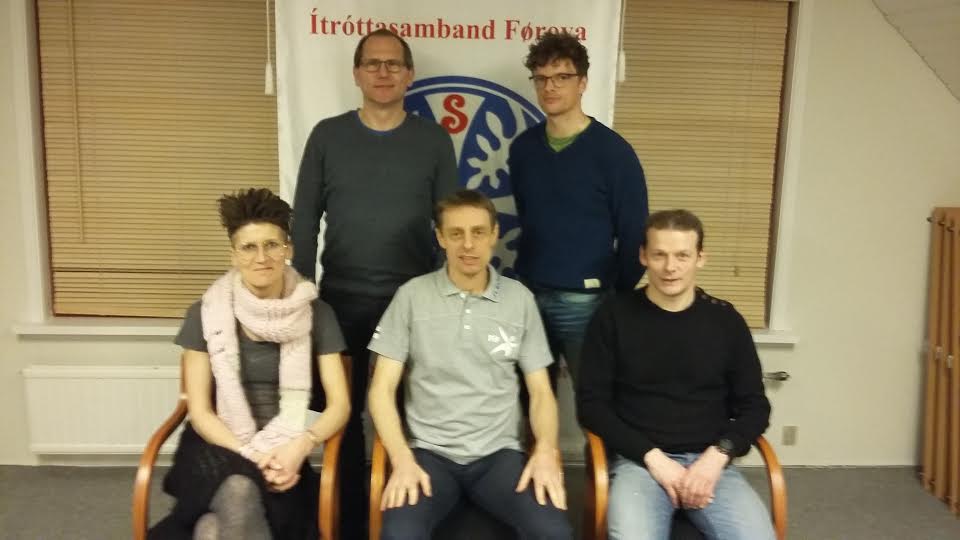
The newly elected board, from left: Rigmor N. Arge, Niels Jákup Jakobsen, Hallur Holm, Regin Thomsen and Guttorm Sørensen
A competition committee was also elected. The current committee of Tummas Nap. Arge, Regin Thomsen, Guttorm Sørensen and Hallur Holm continues. However, the committee is being expanded by one member, as Rúni Seloy is also joining the competition committee.
After a quick coffee break the meeting continued. The first item was staffing a veterans’ committee. It was decided that FÍF and the clubs would talk again in 14 days, and that the clubs would then come forward with proposals for committee members.
The AGM also decided to amend part of article 8 of the statutes, which limited the chair’s tenure to three terms of two years. That limit has now been removed.
Then came any other business. Various topics were raised, and we had some good discussions. The minutes of the meeting can be read directly below this article.
——————————-
FÍF AGM 2015
Minutes
The FÍF annual general meeting was opened shortly after half past six on Thursday evening, 16 April, at the ÍSF building in Gundadalur. The chair welcomed everyone and immediately proposed Niels Jákup Jakobsen as chair of the meeting. As usual, he was elected by acclamation.
Niels Jákup first confirmed that the meeting had been duly convened. It could also be confirmed that attendance was good. Present on behalf of Bragdið: Ann Thomsen, Rúni Seloy and Herluf Jakobsen. On behalf of Frælsi: Súsan Tavsen, Beinta Enni and Laila Jacobsen. On behalf of Hvirlan: Helgi Geyti and Anna Simonsen. On behalf of Roysnið: Arnfinn Johannesen and Regin Thomsen. On behalf of Treysti: Jorie Josephsen and Karin Kirke Petersen. And on behalf of the board: Rigmor N. Arge, Hallur Holm, Guttorm Sørensen and Niels Jákup Jakobsen. Apologies from Jonhard Larsen – his seat was taken by Regin Thomsen, substitute member.
The chair of the meeting handed back to the chair for this year’s chair’s report, which can be read below these minutes. The chair’s report did not give rise to much discussion. One question concerned the date and standard for travelling with the national team to Iceland. The deadline for qualification is GP3, and it is the elite standard that must be achieved. Regarding the officials’ course, the AGM concluded that it will not be necessary to move it. The officials’ course will therefore be held on 24 and 25 May. The clubs were urged to work hard to get as many people as possible onto the officials’ course. The more people who can officiate, the more shoulders there are to share the work.
The treasurer then presented the audited accounts. The accounts were approved.
Next came the board elections. Up for election were the vice-chair, Niels Jákup Jakobsen, and the board members Rigmor N. Arge and Jonhard Larsen. First the vice-chair was to be elected. Niels Jákup accepted re-election, and as there was no other candidate, he was elected vice-chair for the next two years. Then came the election of board members. Rigmor N. Arge was willing to serve another two years, while Jonhard Larsen did not stand again. In his place the board proposed Regin Thomsen. He has served as a substitute member. There were no other candidates, so Rigmor and Regin will also sit on the board for the next two years.
The next item was staffing the subcommittees. FÍF has only one subcommittee – the competition committee, which is elected for one year at a time. The four who sat on the committee previously will continue. In addition, Rúni Seloy will also sit on the competition committee. The committee is thus made up as follows: Guttorm Sørensen, Regin Thomsen, Tummas Napoleon Arge, Rúni Seloy and Hallur Holm.
After a short coffee break the meeting resumed. The next item was staffing a new subcommittee. At its board meetings the executive committee has discussed setting up a veterans’ committee to organise and coordinate work with veterans. We envisage that such a committee could receive a certain budget allocation from FÍF to work with. The committee would draw up its own policy, coordinate calendars, and could for example hold Faroese Track and Field Championships. The possibilities are many. All the clubs have been offered a seat on the committee. Under the regulations, a member of the FÍF board must chair every subcommittee. It was agreed that the clubs would have 14 days to consider this. FÍF will then come back to them, and we will see whether there is a basis for establishing this subcommittee.
That concluded the committee elections. The next item on the agenda was an amendment to the statutes. A proposal had been submitted to remove part of article 8, which limits the chair’s tenure to three terms. The proposal was that this passage in article 8:
“The chair may serve a maximum of three consecutive terms.” …. be deleted. The proposal was adopted. The ÍSF annual general meeting will ratify this amendment.
Next came the election of an auditor. The current auditor, Januar, was re-elected.
Then we came to any other business. First there was a discussion of experiences with Askur, ÍSF’s database system. It was surprising to hear how differently the clubs have experienced the system. Bragdið were very pleased with it. Processing membership fees through the system has gone so well that the club has never before collected so much in membership fees. It was quite the opposite for Roysnið. From having around 100 paying members, the number has fallen all the way to 30. They believe the system itself is the main reason. The extent to which the clubs use Askur varies somewhat. Besides membership administration, some of the clubs also use Askur for registration for various smaller events.
In connection with the Gásadalur Half Marathon, Frælsi had problems with the traffic police, who would not give permission for the race. There was some discussion of what experiences the other clubs have had with police permits, and these were all positive. Niels Jákup is used to handling these matters for Bragdið’s running events, and he undertook to sort things out if the problem arises again this year. There was also discussion of the need for us to take care in traffic, for example by having everyone cross main roads at the same place during running races.
A small comment was made regarding the TF Winter Series. Last year a medal table was produced, clearly showing how many medals the various clubs had won, and some people missed seeing this table again this year. Regin Thomsen, who has administered the points system this winter, promised to produce such a table before too long.
Round 7 of the TF Winter Series was held in Trongisvágur. At the AGM some regretted that almost nobody from down there took part in the race, and that it therefore made little sense for 50 people to spend a whole day on Suðuroy. There were many events on Suðuroy that day, which may have been one reason for the poor local turnout. Some felt that because the races further north start at 11:00, people from Suðuroy find it hard to take part, and so never become part of the TF Winter Series. It was also pointed out that FÍF’s task is to develop athletics throughout the country.
The entry fee for running races was also discussed. More and more races now cost considerably more than the usual 50 DKK, which has been the standard price for many years. This may well put people off. In any case, it should be noticeable that you get more for your money. But there may be a risk in raising prices at a time when the range of events is so large and growing.
It was also pointed out that more and more seems to be concentrated in Tórshavn. The village races in, for example, Vestmanna, Sundalagið, Skáli and Strendur have been discontinued – at least as part of the Grand Prix.
In this connection there was also discussion of whether Svangaskarð could possibly be used for a round of the Track Grand Prix. But that is hardly feasible. Long sprints are impossible because the outer lanes are undermined. Of the throwing events, only the shot put can be held, and the long jump pit is in poor condition, though it could perhaps be made usable with new sand. But under the format the competition has used, many events must be held each time, and so Svangaskarð cannot be used.
The meeting closed at 21:35.
————————————-
Frælsur Ítróttur Føroya
Chair’s report 2015
Another year has passed, and we now stand on the threshold of my final year in which, under the statutes, I can serve as chair. All well and good. Two years ago I recommended that if people wanted a different course and fresh initiatives, they should look for another chairman/chairwoman for the 2014 AGM. Nobody came forward then, but that does not mean there cannot be various wishes for new thinking.
Open meeting
The board therefore felt that something ought to be done to hear what the wider membership had to say about everything going on in athletics. We wanted to sound out opinion and find out whether we were more or less on the right course. The result was a so-called open meeting (“Stórfundur”), held at the school on Løgmannabreyt on 8 October 2014, after being postponed for a week because of bad weather.
The meeting was well attended. First some common topics were discussed, and then we split into two groups: recreational running and track/elite/coaches. At the end everyone came together again. It was a good meeting, and the board received a lot of feedback. In some areas our members are very satisfied with events and plans, while in other areas views differ somewhat. The most important thing is that the board now knows what opinions exist in the clubs, and the clubs know FÍF’s situation.
We are glad we held the meeting. However, it is unlikely that such a meeting will be held every year. It could be a useful tool for future boards to sound out opinion and hear what is really going on in the field.
Finances
For the past two years FÍF has run a deficit. In 2013 the deficit came to around 100,000 DKK. This made the board work even harder to raise money while at the same time keeping spending down. We have gained a main sponsor as well as an increased grant from ÍSF. As we will hear later when the accounts are presented, we have managed to right the ship. But the figures of recent years indicate that the board ought to have a more detailed budget.
FÍF, Hvirlan, Bragdið, the Municipality and Tórsbreyt
Cooperation between Hvirlan, Bragdið and FÍF regarding the facilities at the Tórsbreyt track has gone well. The Municipality usually shows goodwill when we push, and many of the issues we discussed at the meetings last year have been resolved. We are particularly pleased with the large amount of new equipment that has arrived at Tórsbreyt. A few loose ends can be dealt with very soon this spring: internet, lighting, fixed tables and cupboards in the technical room, and new guidelines for the use of Tórsbreyt.
Large or costly tasks still remain, however: pole vault facilities, a sound system, spectator areas and expansion of the storage rooms. In addition, the track will soon need re-marking, and new kerbs must be installed. These tasks must not be forgotten.
On top of all this, there is also a great need for changing facilities.
Cooperation with the clubs has also been about securing opportunities for athletics to train indoors. But exactly what will happen with the expansion of the Gundadalur hall we do not know. What is very exciting, though, is that the Municipality, by all indications, is now going to lay two lanes under the stands at Tórsvøllur. A jumping pit is also expected, so there will be big improvements for next winter. This has come about after representatives of Hvirlan talked to the architect and the Municipality.
And I must also stress how incredibly good it felt to hear that Klaksvík Town Council had set aside money for a running track. We understand those plans are proceeding.
Faroe Islands – Iceland
The ties between the sister nations of the Faroe Islands and Iceland remain strong in athletics. For a long time there were plans to organise an IAAF coaching course here at home, run by Icelanders. However, most felt this would be too extensive, and the plan has now been dropped. But the plan to hold an officials’ course with an Icelandic instructor is now going ahead. Thorsteinn Thorsteinsson, technical director at FRÍ, is scheduled to come here to hold the course on 24 and 25 May. But as this falls at Whitsun, it will have to be changed. We will find a new date as soon as possible.
Cooperation with the Icelanders on results and statistics is also continuing. The Icelanders’ new system is now running on their website, and Guttorm brought home from Reykjavík in January a memory stick containing the software. So now we need to get some computer-savvy people to install the software on our website and get it up and running. How quickly or how difficult this will be is hard to say right now.
There has not been much panic over the statistics, because we now have Regin Reinert, who collects all our results and puts them into his own home-made system. But of course we want all results and statistics to be available to the public.
International cooperation
International cooperation is also a recurring item in the chair’s report. But if we ask whether we are any closer to IAAF membership, the honest answer has to be no. It is nevertheless necessary for us to show who we are, and when I asked the new chair of DAF, Karsten Munkvad, whether the Faroese could send a representative to Iceland for the Nordic congress, the answer was yes. The meeting was moved to Prague in connection with the European Indoor Championships, and the FÍF chair was invited to join the Danish delegation.
In the same letter he invited Faroese representatives to the so-called annual gathering. This is a two-day event including an open meeting, an annual general meeting, lectures, a social evening and a gala dinner. Guttorm and Hallur attended. We got to talk to a great many people and have come to know practically all the staff and the whole board of DAF. This will make it much easier and smoother to cooperate on various matters in the future.
The Norwegian athletics federation also got a new chair earlier this year. He is an ambitious man, Svein Arne Hansen, who last week was elected president of the EAA, the European Athletic Association. Hopefully this can help us in the Faroes in some way. Svein Arne is known for supporting the smaller nations. FÍF has congratulated him, and he has replied to us and would be glad to hear more about us.
It is therefore crucial that we are represented at the next Nordic meeting, where we can get to talk to all the top people there. – Could we perhaps later host the Nordic Congress in the Faroes? Could we organise the Nordic 10,000 m Championships in the Faroes? The Nordic Cross-Country Championships? And if the IAAF is off-limits, how far can we get with the EAA??
Nordic competitions
Being part of the international community also means competing under Merkið, the Faroese flag, where possible. And in May there was once again the Nordic Challenge – the Nordic 10,000 m Championships, held at the legendary Bislet Stadium in Oslo. Valborg Heinesen and Marnar Djurhuus had both shown great form at the World Half Marathon Championships, and both had a chance to set Faroese records over 10,000 m at the Nordic Championships.
But it was not to be. Valborg fell ill and could not travel to Oslo. Marnar did go, but during the race he had back problems and had to drop out after 4,000 metres.
The Nordic Challenge is now approaching again and will be held in Aarhus on 23 May. The invitation to that competition will come from DAF any day now. The board has set qualification standards for the competition: 32 min for men and 37 min for women.
In November the Nordic Cross-Country Championships will be held in Finland. Young athletes can also take part in this competition, and it is also a team competition.
VU-Spelen
Once again this year a large group went to VU-Spelen in Gothenburg. It was the biggest group ever: 22 athletes and four team leaders, plus some parents. The results were outstanding. We got four new Faroese records. Hanus Bergsson twice improved the Faroese record in the javelin. With 59.00 metres he won a bronze. Our only medal. Hanus later improved the record again at the Danish Youth Championships to 59.19 and won silver, after leading for a long time.
The other two Faroese records were set by Rebekka Fuglø: 4:35.92 over 1,500 m and 2:14.6 over 800 metres. She improved the latter record to 2:13.62 when she won the Danish title for G22 on the last day of August.
As mentioned, the results in Gothenburg were exceptionally good. Many top-10 placings, personal bests in almost every event, and no fewer than 27 age-group records set by the Faroese participants over those three days!
This year Island Games participants will not be able to compete at VU-Spelen. However, the plan is to go with the younger athletes. The national team should also preferably have more than one assignment a year, and the plan is to take the national team to Iceland the weekend before Ólavsøka, where we can take part as guest competitors in the Icelandic Championships.
Strong results
Outdoors it is still the women who are setting the Faroese records. Young Margit W. Fríðmundsdóttir has taken the records over both 200 and 300 metres. As mentioned, Rebekka Fuglø took the records over 800 and 1,500 metres. Valborg Heinesen has had an outstanding year: a Faroese record and Danish Championship silver over 5,000 metres (17:30.22) and a new Faroese record and bronze at the Danish Marathon Championships (2:49:37). On the other hand, Valborg also lost some records. 2014 gave us yet another top Faroese female runner. Marna Egholm has twice improved the Faroese half marathon record, and has also taken the records at 15 and 20 km. She was the first Faroese woman under 1:20.
The two young Hvirlan girls Edna Maria Debes and Marita K. Petersen also set new jumping records: Edna Maria in the triple jump and Marita in the long jump.
Indoor records have come in great numbers over the past two years. This winter there was a slight lull, however. It is pleasing that one of FÍF’s great gems is sparkling again. At the Stórmót meet, Rúni Seloy finally improved his 800 m time, which he ran in 2009. His time and the new Faroese indoor record is now 1:56.51. The other indoor records were set by Edna Maria Debes, in the 60 m hurdles and triple jump (the first Faroese woman over 10 metres!), and Hildur Poulsen in the 60 m.
DMU
The Danish Youth Championships have been given their own heading in this year’s chair’s report. Hvirlan, Bragdið and Treysti are very loyal in sending their best athletes to both the indoor and outdoor Danish Championships. And although they represent Danish clubs, the Faroese get noticed. This was clearly apparent at the DAF annual meeting. Our young athletes have won no fewer than 14 Danish Championship medals at this year’s competitions. Two were gold. It was Rebekka who won the outdoor Danish titles over 800 and 1,500 m. Indoors she won silver and bronze over these distances. Several javelin throwers were also among the medallists. Hanus Bergsson, Marita K. Petersen and Tróndur Arge won silver and Helgi Geyti won bronze. Hallur Simonsen won silver in the discus, Edna Maria Debes silver in the triple jump and Katarina Høj bronze over both 800 and 1,500 m. Indoors, Tórur Mortensen and Steingrímur Hallsson won silver in the triple jump and 800 m respectively.
Úrval
At the last AGM members were informed about ÍSF’s new support scheme – Úrval. The scheme has now been put into operation, and FÍF submitted three applications, all of which were approved. From Úrval we receive 20,000 DKK for the javelin thrower Hanus Bergsson, 20,000 DKK for the jumper Tórur Mortensen and 91,000 DKK for the long-distance runner Valborg Heinesen.
We are very pleased about this. The applications are based on four-year plans. This should mean that once support is granted, it will probably be granted again next year, provided everything goes according to the plans on which the applications were based. Some work comes with this money. Quarterly reports and quarterly accounts must be produced for each athlete. But we gladly accept that.
The Úrval money is not handed out lightly! We currently have three athletes in the scheme, which is more than any other federation. The swimming federation also has three. But we should not count on getting more athletes into the scheme. If others show results good enough to be considered, we at FÍF will have to prioritise among our athletes. This could be both difficult and unpleasant, but that is often how it is when one person has to be chosen and another left out.
Island Games
The Island Games are approaching. A provisional national squad has been drawn up, from which the final team will be selected. Eight have achieved the performance standard for selection. When we say the performance standard, this refers to the fact that other requirements also apply if you are to represent the Faroes in athletics at the Island Games. Here the board is broadly agreed that national team athletes must genuinely take their sport seriously and be visible in national athletics, both at competitions and in training.
Coaching courses
For several years FÍF has been trying to bring the top Danish coach Thomas Nolan Hansen to the Faroes to run a coaching course. This has now been arranged, and around the turn of April/May two courses will be held. On Friday 1 May there will be a recreational running coaching course, and the following day a coaching course for middle- and long-distance runners with particular focus on middle distance.
The board agreed to continue the Swedish coach education programme with Randi and Hera, where we have now reached training for 14-year-olds. It is hard to find space in the calendar. Spring in particular is busy. In autumn it is easier to find free days, but by then the competition season is over and interest is hardly as great. But we must find a day together with Randi Kúrberg and Hera Ziska. No concrete attempt has yet been made to find a date.
Veterans’ group
There are many veterans in our organisation, and the board is preparing to establish a veterans’ group as a subcommittee of FÍF. Such a veterans’ group could have its own budget and draw up its own veterans’ policy. Each club will be invited to have a committee member. The committee chair will come from the FÍF executive committee. A veterans’ calendar. Its own policy – elite/grassroots/recreational. Faroese Championships for veterans. Nordic Championships both indoors and outdoors – competing as Faroese. Marathon trips? European/World Championships on the track. Danish Championships. Many relevant competitions.
Finally….
…..I would like to wish everyone a good competition season. There are many exciting competitions coming up, so it is important to be ready. I would also like to send heartfelt thanks to all of you who do the heavy lifting in the clubs – in training, in organising competitions and in running the clubs. You do a tremendous job that continually develops athletics in the Faroes.


You must be logged in to post a comment.