
Machine-translated from Faroese and not yet reviewed. Read the original.
On Friday evening FÍF held its annual general meeting in the meeting rooms of Føroya Tele in Hoyvík. It was clear before the meeting that a new chair had to be found, as the chair of the past eight years did not wish to stand for re-election.
Søren Antoft of Bragdið and Sølvi Reinert Hansen of Roysnið were the nominated candidates for chair. Both were given the floor before the vote, and both had set themselves some good goals to work towards. It was Sølvi who won the vote, and he will therefore be chair for the next two years.

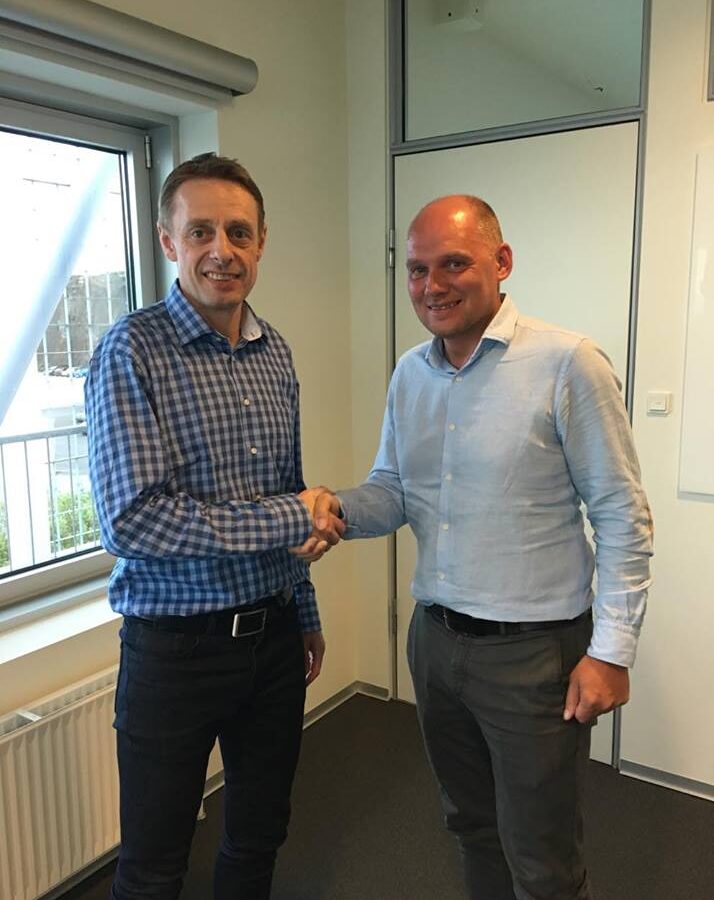
Back to basic. Sølvi Reinert Hansen was FÍF’s first chair, and now returns to the seat that Hallur Holm has held since 2010
Board member Guttorm Sørensen was also up for election. No one stood against him, so he continues on the board for the next two years. The change of chair was therefore the only change to the executive committee, which now looks like this:
- Sølvi Reinert Hansen, chair
- Niels Jákup Jakobsen, vice-chair
- Guttorm Sørensen, treasurer
- Regin Thomsen, secretary
- Rigmor N. Arge
- Karin K. Petersen, 1st substitute member
- Søren Antoft, 2nd substitute member
A competition committee was also elected, consisting of:
- Regin Thomsen, chair
- Guttorm Sørensen
- Søren Antoft
- Rógvi Johansen
The new chair, Sølvi Reinert Hansen, was one of the initiators behind founding Frælsur Ítróttur Føroya in 2002 and was himself the organisation’s first chair until 2006, when Heri Ziska took over. The outgoing chair has served for the past eight years, since 2010.
The final chair’s report can be read below the picture.

FÍF’s new executive committee: From left: Guttorm Sørensen, Niels Jákup Jakobsen, Sølvi Reinert Hansen, Rigmor Napoleonsdóttir Arge and Regin Thomsen
Chair’s report 2017/18
Our sport demands more work than many other sports, and so it is only gratifying that we have many enthusiasts who do an enormous amount of work day in, day out. Fortunately, this effort has been noticed, and some of our enthusiasts have now been honoured.
Last year Heri Ziska won the honour of Leader of the Year at Dansk Atletikforbund, and he was honoured both in Denmark and in the Faroe Islands.
Then, at the beginning of May, it was Guttorm Sørensen who received the Poul E. Peterens honorary diploma. It is an honour awarded for voluntary and selfless work. As Guttorm could not receive the honour, which was presented at the annual general meeting of ÍSF, FÍF, Treysti and Klaksvík Municipality held a reception in the council chamber in Klaksvík, where a large crowd celebrated Guttorm.
Both Heri and Guttorm, together with Absalon Hansen, have been profiled in 3-2, and have thus helped cast a very positive light on athletics.
It is entirely natural that events held by our clubs are, among other things, there to raise money. But it also works the other way. The collaboration that both Frælsi and Bragdið have had with Krabbameinsfelagið and the walking ½ marathon helps raise money for Krabbameinsfelagið. The same applied to the fun run held in connection with Treysti’s NS ½ marathon, where the entry fee went to Sclerosufelagið, and to Jonhard Larsen’s initiative, in which he ran from Klaksvík to Tórshavn to support Alzheimerfelagið. In this way athletics has shown social responsibility, and this has cast a positive light on athletics.
Swedish, or Gotlandic, visit at Easter also gave good media coverage.
For some years we had been thinking about doing something special for athletes and coaches on the track, and about using our connections through, for example, the Island Games. So it had long been a wish to bring Jorma Jaaskelainen and Mattias Sunneborn – top Gotland coaches and former top athletes – to the Faroe Islands. Both are good all-round coaches, and Mattias also had his own story to tell about a rich, exciting sporting life and about Suicide Zero. A successful lecture was organised in the Starvsmannafelag building.
Four different training sessions were also organised: one focusing on jumps, one focusing on sprint, one children’s session with games, and one session for recreational runners.
We are in contact with many different good coaches, and it is of course an option to bring some of them here, both to coach our athletes and to inspire our coaches.
On the sporting side
Island Games
FÍF’s main competition is the Island Games, where we want as large a representation as possible, with athletes who are as competitive as possible.
This year’s result was quite outstanding, with one gold medal, three silver medals and one bronze medal.
Rebekka Fuglø got us started with a Faroese record and bronze in the 1,500 metres. Later in the week she ran home in great style to take gold in the 800 metres
Marna Egholm won silver in both the 10,000 metres and the ½ marathon. The gold and silver times were the second- and third-best times ever in Island Games history, and the story was the same in the half marathon. In both cases gold was incredibly close.
On an ordinary day Tórur Mortensen would easily have won gold in the triple jump, but because of injury things did not go to plan at all. Only one jump was valid. It was enough for a secure silver medal.
We had hoped for these five medals beforehand, although we did not know the colour. But then young Margit Fríðmundsdóttir, completely unexpectedly, won bronze in the triple jump. She was even in silver position right up until the sixth and final round.
It was very positive that we had young girls/women with us who were at their first Island Games. Alda Lamhauge reached the semi-final in the 100 metres, Oddvør Joesephsen was in the 800 m final, Margit Fríðmundsdóttir set a Faroese record in the 200 metres and reached the semi-final, and Elisabet Holm Simonsen was part of both the 4×100 m and the 4×400 m relay teams, which on both occasions set a solid Faroese record and made both finals.
The relays in particular gave team spirit a real boost, and this was also noticeable among all the Faroese spectators in Visby.
Young Julian Gregersen was very close to running his way into the 800 metres final. He fully succeeded in the 1,500, however, where he set a good personal best in the final. The last participant was Jan Elmar Sørensen, who was injured and ran only one of his three entered events. He was a good example of why you should not turn up injured to major competitions with the national team. We were originally meant to be 10 participants, but Rúni Jacobsen unfortunately got injured shortly before departure and withdrew.
VU-Spelen
VU-Spelen started the same weekend that the Island Games ended. So no Island Games athletes took part there. Nevertheless, the squad in Gothenburg was both large and strong. A particularly special result came from Teresa Bláhamar, who set a solid Faroese record in the women’s high jump.
It is very encouraging to see that there are already several athletes who have achieved the Island Games qualification standards and have a chance of going to their first Island Games. Besides Teresa, Sunniva Bogadóttir (javelin) and Guðrið K. Petersen (hammer) have also been above the Island Games standard. In addition, several other young athletes are quite close. Among them are Andreas Antoft, Miso Buha, William Helmsdal and Lydia Simonsen. And there are others too.
Most likely there will be no long throws at the Island Games in Gibraltar. This is an incredibly unfortunate and regrettable situation, now that we have six or seven young women with good chances of qualifying for the Island Games. If so, they should be given another challenge abroad.
Pallas Spelen
We have always wanted our national team athletes to have more than just the one assignment, which has been VU-Spelen and then the Island Games every other year. So this year we went back to the indoor meet Pallas Spelen in Malmö, where we have been twice before. Unfortunately there were some withdrawals due to injury, and some due to expected form. The losses were rather heavy, and the last withdrawal came at the airport itself, when illness struck. In the end only five of the planned 10 took part.
The results were nevertheless quite decent. Rebekka Fuglø won gold in the 1,500 metres, while Alda Lamhauge set a good personal best in the 200 m. Teresa equalled the indoor record in the high jump. Tummas Napoleon was slightly injured and did not run to his best, while Elisabet Holm Simonsen ran steadily well.
The domestic competitions
Track meets continue to decline in participation. The Grand Prix meet, the Faroese Youth Championships and the senior Faroese Championships all face their challenges. We have discussed before whether it is necessary to have both the Faroese Youth Championships and the senior Faroese Championships. That question is perhaps more relevant now than ever.
Although many participants take part in the Winter Series, here too there was a slight decline compared with previous years. This is not at all alarming, though. Many of us still remember when we thought 20 runners in one start was an awful lot.
A trial with ultra-veterans was carried out in the Winter Series, and the competition committee should assess whether this is here to stay or whether to return to the old system.
The once so well-attended summer festival races have now rather faded away. It is a bit like the festivals that are smothering the village festivals – in the same way the big running events are smothering the small races. But with all the many events, you cannot expect crowds everywhere.
The clubs:
Bragdið
The youth section keeps up its efforts year after year at Tórsbreyt. We still see the same people leading the way in coaching. So it is gratifying that new young aspiring coaches have taken responsibility for coaching younger children.
Tórshavn Marathon and Kvinnurenningin are very successful and no less well-attended events, while the Flag Day Run and the Ólavsøka Run have stagnated. On the other hand, the new Faroe Express relay, Stafettin, has become a major event in a very short time. The club outings are very popular
Hvirlan
Over the past 2-3 years Hvirlan has lost many strong young athletes who were also coaches in the club. This is a big loss, and the club now has to find its footing again. Hvirlan organises four exciting events:
Stuttleikir, which is a recruitment event for children at Tórsbreyt and is usually well attended.
Jatnatøk, which was originally intended as an international summer meet. Unfortunately this has not been made to work. One reason may be that Faroese athletes have not supported it well enough. Kerjarenningin, which is a family running event in nature held together with Vetrarrennararnir, and then Mannfólkarenning, which is only for men who want to get dirty and wet. This was a successful event this year, but it should have been possible to get even better participation.
Treysti
There have been rather fewer yellow shirts to be seen at competitions, both on the road and on the track. But with the very exciting project they call Vígvøllurin við Másheyg (the new running track), it is likely that numbers will grow strongly again. And the track will surely influence athletics not only in Klaksvík and the Northern Isles, but throughout the country.
The Faroese Championships NS ½ marathon has been Treysti’s flagship in recent years, and has been exemplarily well organised with good participation. The Føroya Bjór run at Norðoyastevna and Silvarenningin are also recurring running events organised by Treysti. Here participation has fluctuated somewhat.
Frælsi
Føroya Vakrasta hálvmaraton hit the mark when they took over the 1st Saturday in September from Tórshavn Marathon. I don’t think anyone had imagined that 700 participants would come to the event.
Jan Elmar Sørensen has been appointed coach and adviser for recreational runners.
Hvistan
Føroya Sunnasta ½ maraton was very successful last year with over 200 participants, and it looks as though this will be repeated this year. The club training sessions have really taken off and are now held four times a week – twice in Vágur and twice in Tvøroyri.
The new Marghøllin should be able to offer opportunities for both training and competitions, but nothing concrete is planned yet. One idea is that FÍF helps get things going, especially regarding children’s training, if the club is interested.
The hall will be officially opened on Friday 15 June, and the mayor has expressed a wish for someone to come south and demonstrate in practice how the hall can be used for athletics.
Roysnið
Just three years ago the first few green-clad children were seen at competitions at Tórsbreyt. At the first Grand Prix meet this year Roysnið had the second-most starts. The club training sessions have gone well, among other things with various exciting outings and different kinds of runs. A group of beginners has also just started.
The New Year Half Marathon, the Faroese 10 km Championships and Runt Agnið are all well-attended and very well run races organised by Roysnið.
Abroad
Several of the clubs are also very active beyond our shores. Four clubs were represented at Stórmót IR in Reykjavík in January. Then there are Tårnby Games, the training camp in Vaxsjø, the Danish youth championships indoors and outdoors, the Danish Championships outdoors and indoors, and not least all those who travel around the world for marathons and other races.
In Copenhagen last year Cecil Weihe and Krista Nielsen won their age groups in the Copenhagen Marathon, and this year Jens Weihe won his age group, as he has done so often before. Yes indeed, there is ability in the slightly older ones too.
EMA
In August Guttorm and the undersigned went to the European Masters Championships in Aarhus. It was a huge competition, with athletes from 35 to 100 years old competing. The annual general meeting of European Masters was held on the first day, and we from FÍF were invited as observers. It was our friend Kalle Glomsaker from Norway who had put us in contact with the German president, Kurt Kaschke. The following day we had a meeting with the president, where we discussed Faroese membership of EMA. Nothing seems to stand in the way of the Faroe Islands taking part as an independent nation. The Danes got a man elected to the executive committee, which has five members, so together with the president it should have been possible to get an application approved. This was a hot topic in the months that followed, but has now cooled somewhat.
Nordic Athletics
Because it is not that often that we get to compete on an equal footing with other nations. The Nordic Masters Championships will be held in Borås this summer, and some Faroese athletes will be taking part. The Faroese are expected to compete in the Faroese national team kit.
Unfortunately there are not that many other Nordic Championships. In the autumn we had Maria Biskopstø and Oddvør Josephsen at the Nordic Junior Cross-Country Championships. Neither of them was at her best, and that showed in the results. To take part there requires a rather high level, which we do not always have. But when the opportunity is there, we should send people to the Nordic Championships when we can. We have been represented at the Nordic Cross-Country Championships every year since 2014 with one woman: Valborg Heinesen in 2014 and Marna Egholm in the other three years.
Youth camps
Last year the talent training scheme was changed so that all young people, regardless of level, could take part in FÍF’s joint training sessions/events. Just before the last annual general meeting we held such alternative training days at Gjógv, and in November we held an event at Oyrarbakki. We had invited taekwondo coaches to lead a session, and we had advisers from ÍSF to talk about doping. Both events were very successful and popular, but unfortunately participation was far too low.
Work was nevertheless done on a new camp in Vágur in March, where we were given 2 x three hours in Marghøllin as well as unlimited use of Pálshøll and the fitness rooms there. The plan was also to hold a session with children from Vágur and Porkeri, but too little interest meant that all of this was cancelled. The idea is still very good and can be taken up again.
Úrval
Since Úrval started operating in 2015, FÍF athletes have received funding every year. In 2015 it was Valborg Heinesen, while Tórur Mortensen and Hanus Bergsson received a small amount as youth athletes. In 2016 it was Marna Egholm, while Hanus and Tórur now received a slightly higher grant. In 2017 – last year – Tórur and Marna received support. For 2018 Tórur Mortensen has once again received support, while a young women’s group of seven throwers also received an amount.
- Every year FÍF has also applied on behalf of Rebekka Fuglø. Úrval has not been able to grant her money, however, because it is documented that she is not in the top five in the Nordic countries, which is otherwise required under the regulations. Rebekka won gold in all three of her international competitions in 2017/18: Stórmót IR, Pallas Spelen and the Island Games.
So it was striking that another athlete, who is definitely not among the five best in the Nordic countries in their event, could receive full support from Úrval. Not that – most people think this athlete has earned the support. But under the rules it was not possible – the same rule that has been used against Rebekka year after year. That Úrval wants to support an athlete even though its own rules say otherwise means that the rules must be changed.
I have started writing to Úrval about the changes we want. ÍSF is aware of this.
The collaboration regarding Tórsbreyt
The collaboration between Hvirlan, Bragdið and FÍF on the facilities at Tórsbreyt continues. We met with the mayor, the deputy mayor and the culture department, where we explained that the markings on Tórsbreyt had faded, that the track was overgrown with moss, and that we lack lighting, a sound system and pole vault equipment. Already last summer the track was cleaned and re-marked. One million has also been granted in 2018 for lighting. We were subsequently told that we could hope to get a sound system and pole vault equipment spread over two years.
Collaboration on a tunnel run
We had plans to hold a so-called international ultra tunnel run in connection with the opening of the Eysturoyartunnilin in 2020. This was to be a joint project for all the clubs, with the aim, among other things, of making money. A committee was appointed with one representative from each club plus a representative for FÍF. The committee has held one meeting – which by now is quite a while ago.
The first idea was to run from Gásadalur to Hvítanes and then through the Eysturoyartunnilin and finish in Viðareiði. The committee quickly realised, however, that this would hardly make much money and would work poorly as a celebration in connection with the tunnel opening. The conclusion was to have two courses: 10 km from Hoyvík and 5 km from Strendur. Both courses finish with a celebration at the sports centre in Runavík.
I think this is a good proposal that could gather several thousand runners, and if it is handled well, it should be able to bring money into the coffers of all FÍF’s clubs.
But now things must move quickly, because we still have not received permission from the tunnel company, and someone else may be waiting in the wings.
Ultra running – Útiliv
But as early as this autumn an ultra-trail race will be held in the Faroe Islands. Útiliv Adventure Festial Faroe Islands is a huge running event that will take place here in the Faroe Islands from 7 to 9 September. World-famous trail runners are coming here to run a trail race on four different courses in Norðurstreymoy. Faroese sponsors include Nax, Mikkeler, Visit Føroyar and the Scouts. On the Friday evening before the races there will be an exhibition and lectures in the Nordic House, and on the Sunday they will organise all kinds of excursions. Over 200 foreign runners are expected.
I have had a meeting with Sarah Pritchard, who is one of the two main organisers. FÍF should somehow be involved in such a large-scale event, which is in reality a good opportunity to make ordinary Faroese people better acquainted with trail running. We discussed that it should be possible to have a Faroese Championships trail race built into the competition.
The question is also what FÍF should do if this becomes a recurring event. Can outsiders come into our territory? Can anyone organise running races anywhere in the Faroe Islands?
Statistics system
This has been a topic every year: creating a database with all our results. It has been very hard to finally choose a particular solution, because IT is very expensive and it is difficult to judge what you get for your money. But we then decided to work with Klintra, which has capable IT people and also several people with both insight into and interest in athletics.
We have now got so far that we have a Faroese system. It is the Danish one, translated into Faroese and ready to be launched. Now the only question is how it should be filled with all the old results, how it should be updated continuously, and who should do it.
This is a giant leap for our history. It will be possible to make rankings of all kinds, see all of an athlete’s results in one place, etc. Countless possibilities. Those who know the Danish statletik know what I am talking about. This has cost a lot of money, but it is necessary, and we can afford it because we have saved money for, among other things, exactly this.
Finances – sponsors
2017 was an Island Games year, which is usually somewhat more expensive than other years. That was the case this time too, and the Island Games together with the expenses for the statistics database give us a small deficit in 2017. Support from ÍSF will be a little lower in 2018 than in 2017. Sponsorship income is secured three years ahead, up to and including 2020. We have signed a new 3-year contract with Betri as main sponsor, as well as agreements with Hiddenfjord and Føroya Tele – both contracts valid until 2020.
With a budget of around DKK 700,000, FÍF has ample opportunities for varied activities. And if even more activity is created, ÍSF’s system now works in such a way that there is a good chance of extra funding from there.
Thank you from me
I will now say thank you and goodbye. Thank you for eight exciting years at the helm of athletics in the Faroe Islands. Eight years is more than enough, without doubt, and new forces should be given the chance. Thank you for the good collaboration with the clubs, with coaches and athletes, and not least thank you for the good collaboration with all of you on the board. I wish you fair winds onwards – chart your own course.
My final greeting goes to the coaches who, day in, day out, work hard for the progress of others. Without them, it would all be the same.





You must be logged in to post a comment.